>
Gobiiformes (Gobies) >
Gobiidae (Gobies) > Gobiinae
Etymology: Eviota: No etymology given, suggested by Christopher Scharpt: from Latin 'eu' for 'true' and 'iota' for anything very small, in combination 'truly very small' referring to it as being the smallest vertebrate at the time it has benn described by Jenkins (thus, making the suggestion by Scharpt plausible.
More on authors: Lachner & Karnella.
Entorno: milieu / zona climática / rango de profundidad / gama de distribución
Ecología
marino asociado a arrecife; rango de profundidad 1 - 15 m (Ref. 48637). Tropical
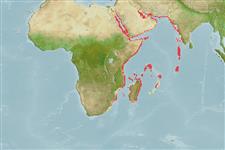
Indian Ocean: Red Sea, Gulf of Aqaba, Gulf of Oman, Seychelles, and Maldives. Records from the Pacific Ocean are most likely E. cf. teresae (except Fiji with E. teresae).
Tamaño / Peso / Edad
Madurez: Lm ? range ? - ? cm
Max length : 3.2 cm TL macho / no sexado; (Ref. 11344)
Descripción breve
Claves de identificación | Morfología | Morfometría
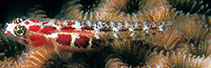
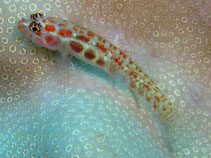
Espinas dorsales (total) : 6 - 7; Radios blandos dorsales (total) : 8 - 9; Espinas anales: 1; Radios blandos anales: 8 - 9. This species is similar to Eviota albolineata in having similar counts or measurements. Color differences in live and preserved materials are distinct, however, with E. guttata having a dark spot on the ventral side of the head on the isthmus, about in line with the posterior portion of the maxilla and presence of a few scattered melanophores on the underside of the lower jaw near the tip, the intensity of the dark pigmentation varies, from a few melanophores to a very dark area (absent in E. albolineata) (Ref. 83982). Dorsal to anal fin-ray formula 9/8 (Ref. 116739).
Body shape (shape guide): elongated; Cross section: oval.
Inhabits shallow reefs with mixed algae and coral growth to about 15 meters depth (Ref. 48637). Occurs in coastal and insular areas.
Ciclo vital y comportamiento de apareamiento
Madurez | Reproducción | Puesta | Huevos | Fecundidad | Larva
Lachner, E.A. and S.J. Karnella, 1978. Fishes of the genus Eviota of the Red Sea with descriptions of three new species (Teleostei: Gobiidae). Smithson. Contrib. Zool. 286:23 p. (Ref. 11636)
Situación en la Lista Roja de la UICN (Ref. 130435: Version 2025-2 (Global))
Amenaza para el ser humano
Harmless
Usos humanos
Herramientas
Informes especiales
Descargar XML
Fuentes de Internet
Estimaciones basadas en modelos
Temperatura preferida (Referencia
123201): 24.7 - 29.3, mean 28.3 °C (based on 3568 cells).
Índice de diversidad filogenética (Referencia
82804): PD
50 = 0.5000 [Uniqueness, from 0.5 = low to 2.0 = high].
Bayesian length-weight: a=0.00794 (0.00405 - 0.01556), b=3.06 (2.89 - 3.23), in cm total length, based on LWR estimates for this species & Genus-body shape (Ref.
93245).
Nivel trófico (Referencia
69278): 3.1 ±0.3 se; based on size and trophs of closest relatives
Resiliencia (Referencia
120179): Alto, población duplicada en un tiempo mínimo inferior a 15 meses (Preliminary K or Fecundity.).
Vulnerabilidad pesquera (Ref.
59153): Low vulnerability (10 of 100).
🛈
Nutrientes (Ref.
124155): Calcium = 367 [158, 1,005] mg/100g; Iron = 1.46 [0.65, 3.21] mg/100g; Protein = 17.7 [15.6, 19.5] %; Omega3 = 0.0971 [, ] g/100g; Selenium = 30.1 [9.5, 85.9] μg/100g; VitaminA = 110 [24, 506] μg/100g; Zinc = 3.96 [2.23, 6.46] mg/100g (wet weight);