Elasmobranchii (haaien en roggen) (sharks and rays) >
Squaliformes (Sleeper and dogfish sharks) >
Somniosidae (Sleeper sharks)
Etymology: Somniosus: Latin for sleepy, reflecting Lesueur’s surmise that these sharks are slow or sluggish because of their relatively small fins (hence the name sleeper sharks) (See ETYFish); pacificus: -icus (L.), belonging to: the Pacific Ocean (specifically, the North Pacific), where it occurs (also in Arctic Ocean) (See ETYFish).
Milieu: milieu / Klimaatzone / Diepte / verspreidingsgebied
Ecologie
marien benthopelagisch; oceanodroom (Ref. 138310); diepte 0 - 2205 m (Ref. 119696). Boreal; 72°N - 23°N, 121°E - 110°W
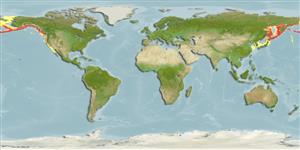
North Pacific and Arctic: Taiwan to Japan and Kuril Islands, Sea of Okhotsk, southeastern Kamchatka, Commander and Aleutian Islands, and southern Baja California to Gulf of Alaska, Bering Sea, Chukchi Sea and Beaufort Sea.
Grootte / Gewicht / Leeftijd
Maturiteit: Lm ? range ? - ? cm
Max length : 440 cm TL mannelijk / geslacht onbekend; (Ref. 247); 430.0 cm TL (female)
Dorsale stekels (totaal) : 0; Anale stekels: 0. Diagnosis: Somniosus pacificus differs from S. antarcticus by the following characters: interdorsal space about 70% of prebranchial length (vs. 80%); height of first dorsal fin about 3.7% of precaudal length (PCL) (vs. 3.0%); height of second dorsal fin about 3.4% of PCL (vs. 2.9%); number of turns in spiral valve 32-37 (mode 33) (vs. 36-41, mode 39); precaudal vertebrae 28-30 (mode 29) (vs. 30-31, mode 30) (Ref. 50224).
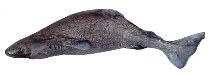
Body shape (shape guide): elongated.
Demersal and mesobenthopelagic (Ref. 119696); found on continental shelves and slopes (Ref. 247). At high latitudes, they occasionally occur in littoral and even intertidal areas; in lower latitudes ithey may never come to the surface and down to at least 2,000 m (Ref. 247), reported to about 2,205 m in the Hawaiian Is. as recorded by camera arrays (Ref. 119696). They feed on bottom animals such as fishes, octopi, squids, crabs and tritons; also harbor seals and carrion (Ref. 247). Ovoviviparous (Ref. 205), with 300 pups in a litter (Ref. 247), length at birth about 42 cm or less (Ref. 26346). The flesh contains a type of toxin which, when eaten, produces symptoms of drunkenness (Ref. 583). Possibly reaches lengths greater than 700 cm (Ref. 247). It is of limited importance in fisheries, with older small-scale commercial harvests reported in southern areas; and based on its population dynamics it can be sensitive to overfishing (Ref. 117245).
Levenscyclus en paargedrag
Maturiteit | Voortplanting | Paaien | Eieren | Fecunditeit | Larven
Probably ovoviviparous (Ref. 247). Size at birth 42 cm or less (Ref. 26346). Distinct pairing with embrace (Ref. 205).
Yano, K., J.D. Stevens and L.J.V. Compagno, 2004. A review of the systematics of the sleeper shark genus Somniosus with redescriptions of Somniosus (Somniosus) antarcticus and Somniosus (Rhinoscymnus) longus (Squaliformes: Somniosidae). Ichthyol. Res. 51:360-373. (Ref. 50224)
Status op de Rode Lijst van het IUCN (Ref. 130435: Version 2025-2 (Global))
Gebruik door de mens
Visserij: van geen belang
Tools
Speciale rapporten
Download XML
Internetbronnen
Schattingen op basis van modellen
Gewenste temperatuur (Ref.
123201): 0.5 - 4.5, mean 2.3 °C (based on 400 cells).
Fylogenetische diversiteitsindex (Ref.
82804): PD
50 = 0.5156 [Uniqueness, from 0.5 = low to 2.0 = high].
Bayesian length-weight: a=0.00575 (0.00319 - 0.01039), b=3.09 (2.93 - 3.25), in cm total length, based on LWR estimates for this species & (Sub)family-body (Ref.
93245).
Trofisch niveau (Ref.
69278): 4.4 ±0.4 se; based on diet studies.
Weerstandsvermogen (Ref.
120179): laag, minimale populatieverdubbelingstijd 4,5-14 jaar (Fec=300; assuming tm<=10).
Kwetsbaarheid van de visserij (Ref.
59153): Very high vulnerability (90 of 100).
🛈
Kwetsbaarheid voor het klimaat (Ref.
125649): Moderate vulnerability (38 of 100).
🛈