>
Osmeriformes (Freshwater smelts) >
Osmeridae (Smelts)
Etymology: Osmerus: Greek, osme = odorous; similar to freshly cut cucumbers (Ref. 45335); mordax: mordax meaning biting (Ref. 10294).
More on author: Mitchill.
Milieu: milieu / Klimaatzone / Diepte / verspreidingsgebied
Ecologie
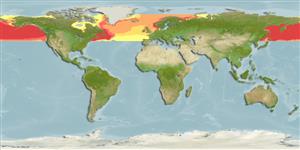
marien; zoet water; brak water pelagic-oceanic; anadroom (Ref. 138124); diepte 0 - 425 m (Ref. 58426), usually ? - 150 m (Ref. 96339). Temperate; 6°C - 18°C (Ref. 1998); 73°N - 41°N, 167°W - 53°W (Ref. 86798)
North Atlantic: Atlantic drainages from Lake Melville in Newfoundland and Labrador, Canada to Delaware River in Pennsylvania, USA and west through Great lakes. Arctic and Pacific drainages from Bathurst Inlet, Northwest Territories to Vancouver Island in British Columbia, Canada. Also Pacific drainages of Asia.
Lengte bij maturiteit / Grootte / Gewicht / Leeftijd
Maturiteit: Lm 19.5 range ? - 19.8 cm
Max length : 35.6 cm TL mannelijk / geslacht onbekend; (Ref. 1998); max. gerapporteerde leeftijd: 7 Jaren (Ref. 52222)
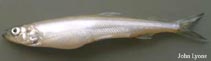
Dorsale stekels (totaal) : 0; Dorsale zachte stralen (totaal) : 8; Anale stekels: 0; Anale zachte stralen: 12 - 16; Wervels: 58 - 70. Body elongate, laterally compressed, greatest depth at anterior of dorsal fin origin. Head moderate; eye moderately large; snout elongate, pointed. Mouth large; lower jaw protruding, maxillary extending to middle of eye or beyond, well toothed on vomer, palatine, pterygoid, basibranchial, dentary, maxillary, and tongue. Teeth specially enlarged on tongue and front of vomer. Body color is pale green on back, with purple, blue, and pink iridescent reflections on the side when freshly caught.
Body shape (shape guide): elongated; Cross section: compressed.
Nerito-pelagic (Ref. 58426). Inhabits cool clear lakes, medium to large rivers, and coastal waters (Ref. 86798). A schooling species that occurs in midwater of lakes or inshore coastal waters (Ref. 1998); at temperatures ranging from 7.2-15.6°C. Coastal population are anadromous (Ref, 86798). Migrates up to 1,000 km upstream in rivers (Ref. 6793). Occurs possibly to 425 m (Ref. 2851). Feeds on invertebrates such as amphipods, ostracods, aquatic insect larvae and aquatic worms (Ref. 1998); food also include copepods, euphausiids, mysids and small fishes (silversides, mummichogs and herring) (Ref. 5951, 10294). Headed, gutted, sold fresh, frozen and precooked. Eaten sautéed and fried (Ref. 9988).
Spawning runs occur when temperature is between 8.9-18.3°C, may last for 3 weeks, peak for 1 week. Lengths of both sexes decrease as spawning progress. Two or more tuberculated males maintain position against a female in swift water, eggs released in clusters and presumably milt released simultaneously. Spawning usually takes place at night, spawners move downstream to the lake during daytime.
Mecklenburg, K.C., P.R. Møller and D. Steinke, 2011. Biodiversity of the Arctic marine fishes: taxonomy and zoogeography. Marine Biodiversity 41(1):109-140. (Ref. 86838)
Status op de Rode Lijst van het IUCN (Ref. 130435: Version 2025-2 (Global))
Gevaar voor de mens
Harmless
Gebruik door de mens
Visserij: commercieel; sportvis: ja
Tools
Speciale rapporten
Download XML
Internetbronnen
Schattingen op basis van modellen
Gewenste temperatuur (Ref.
123201): 0.2 - 6.9, mean 2.7 °C (based on 724 cells).
Fylogenetische diversiteitsindex (Ref.
82804): PD
50 = 0.5625 [Uniqueness, from 0.5 = low to 2.0 = high].
Bayesian length-weight: a=0.00407 (0.00327 - 0.00508), b=3.15 (3.08 - 3.22), in cm total length, based on LWR estimates for this species (Ref.
93245).
Trofisch niveau (Ref.
69278): 3.0 ±0.0 se; based on diet studies.
Weerstandsvermogen (Ref.
120179): Gemiddeld, minimale populatieverdubbelingstijd 1,4-4,4 jaar (K=0.31; tm=2-6; tmax=6; Fec=8,500).
Kwetsbaarheid van de visserij (Ref.
59153): Moderate vulnerability (38 of 100).
🛈
Kwetsbaarheid voor het klimaat (Ref.
125649): Low to moderate vulnerability (32 of 100).
🛈
Voedingsstoffen (Ref.
124155): Calcium = 55.1 [21.0, 119.8] mg/100g; Iron = 0.477 [0.226, 1.202] mg/100g; Protein = 17.6 [14.6, 20.0] %; Omega3 = 0.853 [0.430, 1.777] g/100g; Selenium = 14.5 [6.4, 42.4] μg/100g; VitaminA = 14 [4, 47] μg/100g; Zinc = 0.827 [0.530, 1.309] mg/100g (wet weight); based on
nutrient studies.