>
Anabantiformes (Gouramies, snakeheads) >
Osphronemidae (Gouramies) > Macropodusinae
Etymology: Betta: Malay/Javanese origin. Bleeker (1850, 1858) indicates Ikan Wadder Bettah as the local name of Betta trifasciata Bleeker, 1849 (now Betta picta, Valenciennes, 1846) in the Ambarawa Javanese dialect. Ikan Wader is a common Javanese name for smaller freshwater fishes, especially cyprinids (already used in Old Javanese). See Blust, R. & Trussel, S. Austronesian Comparative Dictionary. Web Edition (https://www.trussel2.com/acd/).
More on authors: Witte & Kottelat.
Meio ambiente: milieu / Zona climática / intervalo de profundidade / faixa de distribuição
Ecologia
; Água doce bentopelágico. Tropical; 22°C - 26°C (Ref. 12468)
Asia: Indonesia.
Tamanho / Peso / Idade
Maturidade: Lm ? range ? - ? cm
Max length : 3.5 cm TL macho/indeterminado; (Ref. 7050)
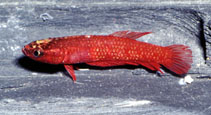
Belongs to the Betta coccina complex which is distinguished by having only 9 abdominal vertebrae (vs. 10-11 in all other Betta) and usually a deep red color. Within this complex, Betta persephone is distinguished by its blackish coloration. Betta rutilans shares with Betta tussyae, a modal dorsal ray count of 12 (vs. 10 and 11 in other species of the complex), a modal subdorsal scale count of 9 (vs. 7), a greater length of dorsal base (20-23% SL, vs. 14-19), absence of a midlateral blotch (vs. usually present in male Betta coccina and Betta sp. Witte & Schmidt, submitted) and white pelvic filament (vs. black in Betta coccina). Betta rutilans differs from Betta tussyae by a lower mode in dorsal (I, vs. II) and anal spines (II, vs. III), smaller size (up to 25 mm SL, vs. 48, aquarium specimens), and absence of bluish green spots on proximal areas of unpaired fins (vs. usually present). The single cleared and stained specimens is apparently distinguished from all other Betta by having fused hypurals 6 and 7 (Ref. 26721).
Body shape (shape guide): fusiform / normal.
Facultative air-breathing (Ref. 126274)
Ciclo de vida ou comportamento de acasalamento
Maturidade | Reprodução | Desova | Ovos | Fecundidade | Larvas
Kottelat, M., A.J. Whitten, S.N. Kartikasari and S. Wirjoatmodjo, 1993. Freshwater fishes of Western Indonesia and Sulawesi. Periplus Editions, Hong Kong. 221 p. (Ref. 7050)
Status na Lista Vermelha da UICN (Ref. 130435: Version 2025-2 (Global))
Ameaça para os humanos
Harmless
Uso pelos humanos
Ferramentas
Relatórios especiais
Baixar XML
Fontes da internet
Estimativas baseadas em modelos
Índice de diversidade filogenética (Ref.
82804): PD
50 = 0.5000 [Uniqueness, from 0.5 = low to 2.0 = high].
Bayesian length-weight: a=0.01000 (0.00374 - 0.02675), b=2.97 (2.74 - 3.20), in cm total length, based on LWR estimates for this (Sub)family-body shape (Ref.
93245).
Nível Trófico (Ref.
69278): 3.1 ±0.4 se; based on size and trophs of closest relatives
Resiliência (Ref.
120179): Elevada, tempo mínimo de duplicação da população menor que 15 meses (Preliminary K or Fecundity.).
Vulnerabilidade da pesca (Ref.
59153): Low vulnerability (10 of 100).
🛈