Taxonomic Remarks
The species was placed in the genus Bathyphasma Gilbert, 1896 by Balushkin (2012), genus he resurrected on the basis of a few characters. He was followed by authors thereafter but with no supplementary evidence. Orr et al. (2019) did not support the resurrection from their phylogeny, on the basis of a lack or morphological synapomorphies with other sister-species, which we follow in FishBase and WoRMS. As Bathyphasma ovigerum Gilbert 1896 in ECoF (March 2024).
Umwelt: Milieu / Klimazone / Tiefenbereich / Verbreitungsgebiet
Ökologie
seewasser bathydemersal; tiefenbereich 1920 - 2910 m (Ref. 6885). Deep-water
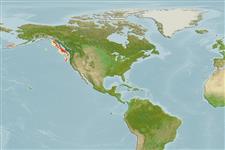
Northeast Pacific: off northern British Columbia. Occurrence record from Washington (Ref. 5515).
Größe / Gewicht / Alter
Geschlechtsreife: Lm ? range ? - ? cm
Max length : 43.1 cm SL Männchen/unbestimmt; (Ref. 12204)
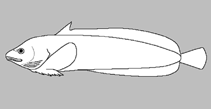
Rückenflossenstacheln (insgesamt) : 0; Rückenflossenweichstrahlen (insgesamt) : 40 - 45; Afterflossenstacheln: 0; Afterflossenweichstrahlen: 35 - 36; Wirbelzahl: 45 - 50. This species is distinguished from its congeners by the following set of characters: both jaws with narrow rows of stout, sharp, simple, recurved teeth; a moderate-sized gill opening which extends ventrally to pectoral rays 4-8; pelvic disk large 25-38% HL; cephalic pore pattern 2-6-7-1; most similar to C. lycopersicus and C. kamikawai, which are both distinguished from C. ovigerus by their broad bands of trilobed teeth (Ref. 91047).
Body shape (shape guide): elongated.
The holotype, a male, was found to carry developing eggs in its mouth (Ref. 6885). Two females were ripe with large yolked eggs 6-7 mm in diameter, while the male of 33.0 cm SL had enlarged testes. Two smallest and immature females examined (18.0-18.5 cm SL) had small ovaries with many small white eggs ca. 1 mm in diameter (Ref. 91047).
Lebenszyklus und Paarungsverhalten
Geschlechtsreife | Fortpflanzung | Ablaichen | Eier | Fruchtbarkeit | Larven
McAllister, D.E., 1990. A list of the fishes of Canada. Syllogeus No. 64. Nat. Mus. Nat. Sci., Ottawa, Canada. 310 p. (Ref. 11980)
IUCN Rote Liste Status (Ref. 130435: Version 2025-2 (Global))
Bedrohung für Menschen
Harmless
Nutzung durch Menschen
Fischereien: nicht kommerziell
Tools
Zusatzinformationen
Download XML
Internet Quellen
Schätzungen auf der Grundlage von Modellen
Bevorzugte Temperatur (Ref.
123201): 1.7 - 1.9, mean 1.9 °C (based on 7 cells).
Phylogenetischer Diversitätsindex (Ref.
82804): PD
50 = 0.5000 [Uniqueness, from 0.5 = low to 2.0 = high].
Bayesian length-weight: a=0.00447 (0.00203 - 0.00984), b=3.17 (2.99 - 3.35), in cm total length, based on LWR estimates for this Genus-body shape (Ref.
93245).
Trophische Ebene (Ref.
69278): 3.4 ±0.5 se; based on size and trophs of closest relatives
Widerstandsfähigkeit (Ref.
120179): mittel, Verdopplung der Population dauert 1,4 - 4,4 Jahre. (Preliminary K or Fecundity.).
Anfälligkeit der Fischerei (Ref.
59153): Moderate vulnerability (41 of 100).
🛈