Myxine glutinosa, Atlantic hagfish

You can sponsor this page

Myxine glutinosa Linnaeus, 1758

Atlantic hagfish
Adicionar as suas observações no Fish Watcher
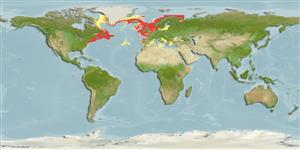
Native range
This map was computer-generated and has not yet been reviewed.
Myxine glutinosa   AquaMaps   Data sources: GBIF OBIS
Adicionar o seu Fotografias e vídeos
Fotografias | vídeos | Imagem do Google
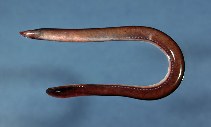
Image of Myxine glutinosa (Atlantic hagfish)
Myxine glutinosa
Fotografia de Flescher, D.

Classificação / Nomes Nomes comuns | Sinónimos | Catalog of Fishes(Género, Espécies) | ITIS | CoL | WoRMS | Cloffa

Myxini (mixinas) (hagfishes) > Myxiniformes (Hagfishes) > Myxinidae (Hagfishes) > Myxininae
Etymology: Myxine: Ancient Greek word for a slimy fish: myxa, slime; -inus, one who, referring to copious amounts of slime produced by M. glutinosa (See ETYFish)glutinosa: Latin for viscous or sticky, referring to its seeming ability to turn water into slime (See ETYFish).
More on author: Linnaeus.

Ambiente: milieu / zona climática / intervalo de profundidade / gama de distribuição Ecologia

marinhas batidemersal; não migratória; intervalo de profundidade 20 - 1200 m (Ref. 117245), usually 27 - 460 m (Ref. 119696). Boreal; 2°C - 13°C (Ref. 119696); 72°N - 24°N, 89°W - 41°E

Distribuição Territórios | Áreas FAO | Ecossistemas | Ocorrências | Mapa dos pontos | Introduções | Faunafri

North Atlantic: Murmansk to the Mediterranean Sea; Greenland to USA. Absent in eastern Mediterranean and Black Sea. Only hagfish in the Northeast Atlantic.

Comprimento na primeira maturidade / Tamanho / Peso / Idade

Maturidade: Lm ?, range 25 - ? cm
Max length : 95.0 cm TL macho/indeterminado; (Ref. 119696); common length : 30.0 cm TL macho/indeterminado; (Ref. 35388); common length :40 cm TL (female)

Descrição breve Chaves de identificação | Morfologia | Morfometria

Jawless mouth, single nasal aperture, only a single pair of external gill openings, no operculum or covering fold of skin. Grayish or reddish brown above, either plain. Variations in color correspond to the color of the sea bottom.
Body shape (shape guide): eel-like.

Biologia     Glossário (ex. epibenthic)

Benthic with reported depths to 782 off Greenland; 960 m in Northwestern Atlantic; and 1,100 m off Norway (Ref. 119696). Found on muddy bottoms where they hide in the mud. Slime is used for defense. Feeds chiefly on dead and dying fish of varying species by boring into the body and consuming viscera and musculature. Chiefly nocturnal. Its eggs are few in number about 19-30 and large (20-25 mm), the horny shell has a cluster of anchor-tipped filaments at each end.

Ciclo de vida e comportamento de acasalamento Maturidade | Reprodução | Desova | Ovos | Fecundidade | Larvas

Copulatory organ absent. The gonads of hagfishes are situated in the peritoneal cavity. The ovary is found in the anterior portion of the gonad, and the testis is found in the posterior part. The animal becomes female if the cranial part of the gonad develops or male if the caudal part undergoes differentiation. If none develops, then the animal becomes sterile. If both anterior and posterior parts develop, then the animal becomes a functional hermaphrodite. However, hermaphroditism being characterised as functional needs to be validated by more reproduction studies (Ref. 51361 ). Probably breed throughout the year in deep water (Ref. 35388).

Referência principal Carregar as suas referências | Referências | Coordenador | Colaboradores

Fernholm, B., 1998. Hagfish systematics. p. 33-44. In J.M. Jørgensen, J.P. Lomholt, R.E. Weber and H. Malte (eds.) The biology of hagfishes. Chapman & Hall, London. 578 p. (Ref. 31276)

Categoria na Lista Vermelha da IUCN (Ref. 130435: Version 2025-2 (Global))

  Preocupação menor (LC) ; Date assessed: 12 November 2009

CITES

Not Evaluated

CMS (Ref. 116361)

Not Evaluated

Ameaça para o homem

  Harmless


Utilização humana

Pescarias: sem interesse
FAO - Publication: search | FishSource | Sea Around Us

Mais informação

Ecologia Trófica
Produtos alimentares (presas)
Composição da dieta
Consumo alimentar
Rações alimentares
Predadores
Ecologia
Ecologia
Dinâmica das populações
Parâmetros de crescimento
Idades / tamanhos máximos
Comprimento-peso rel.
Comprimento-comprimento rel.
Frequência de comprimento
Conversão de massa
Recrutamento
Abundância
Ciclo de vida
Reprodução
Maturidade
Maturidade/Rel. das guelras
Fecundidade
Desova
Agregações de desova
Ovos
Desenvolvimento dos ovos
Larvas
Dinâmica larvar
Distribuição
Territórios
Áreas FAO
Ecossistemas
Ocorrências
Introduções
BRUVS - Vídeos
Anatomia
Área branquial
Cérebro
Otólitos
Fisiologia
Composição corporal
Nutrientes
Consumo de oxigénio
Tipo de natação
Velocidade de natação
Pigmentos visuais
Som de peixe
Doenças e Parasitas
Toxicidade (LC50s)
Genética
genoma
Genética
Heterozigotia
Hereditariedade
Diversidade genética
Relacionado com o ser humano
Sistemas de aquacultura
Perfis para aquacultura
Estirpes
Casos de Ciguatera
Selos, moedas, diversos.
Divulgação
Colaboradores
Referências
Referências

Ferramentas

Relatórios especiais

Descarregue XML

Fontes da internet

AFORO (otoliths) | Aquatic Commons | BHL | Cloffa | Websites from users | Consultar FishWatcher | CISTI | Catalog of Fishes: Género, Espécies | DiscoverLife | ECOTOX | FAO - Publication: search | Faunafri | Fishipedia | Fishtrace | GloBI | Google Books | Google Scholar | Google | IGFA World Record | Bases de dados nacionais | OceanAdapt | OneZoom | Open Tree of Life | Otolith Atlas of Taiwan Fishes | PubMed | Reef Life Survey | Socotra Atlas | TreeBase | Árvore da vida | Wikipedia: ir para, procurar | World Records Freshwater Fishing | Zoobank | Registo zoológico

Estimativas baseadas em modelos

Temperatura preferida (Ref. 123201): 1 - 10.2, mean 5.3 °C (based on 550 cells).
Índice de diversidade filogenética (Ref. 82804):  PD50 = 0.5000   [Uniqueness, from 0.5 = low to 2.0 = high].
Bayesian length-weight: a=0.00115 (0.00045 - 0.00294), b=3.03 (2.81 - 3.25), in cm total length, based on LWR estimates for this (Sub)family-body shape (Ref. 93245).
Nível Trófico (Ref. 69278):  4.5   ±0.0 se; based on diet studies.
Resiliência (Ref. 120179):  Baixo, tempo mínimo de duplicação da população 4,5 - 14 anos (Fec= 20-30).
Prior r = 0.10, 95% CL = 0.07 - 0.15, Based on 1 full stock assessment.
Vulnerabilidade da pesca (Ref. 59153):  High vulnerability (58 of 100). 🛈
Vulnerabilidade climática (Ref. 125649):  Moderate vulnerability (38 of 100). 🛈
Nutrientes (Ref. 124155):  Calcium = 7.79 [2.08, 25.45] mg/100g; Iron = 0.278 [0.095, 0.782] mg/100g; Protein = 2.26 [0.00, 6.14] %; Omega3 = 0.301 [0.116, 0.790] g/100g; Selenium = 18.8 [5.5, 64.6] μg/100g; VitaminA = 11 [2, 52] μg/100g; Zinc = 0.281 [0.133, 0.569] mg/100g (wet weight);