Myxini (hagfishes) (hagfishes) >
Myxiniformes (Hagfishes) >
Myxinidae (Hagfishes) > Eptatretinae
Etymology: Eptatretus: hepta (Gr.), seven; tretos (Gr.), perforated (i.e., with holes), referring to seven gill apertures on what would later be described as Homea banksii (=E. cirrhatus) [range within genus is 6-14 pairs of gill apertures] (See ETYFish); stoutii: In honor of Arthur B. Stout (1814-1898), surgeon and corresponding secretary of the California Academy of Sciences [see box, below] (See ETYFish).
Eponymy: Dr Arthur Breese Stout (1814–1898) was a prominent surgeon in San Francisco. [...] (Ref. 128868), visit book page.
Lingkungan: lingkungan / zona iklim / kisaran kedalaman / jangkauan distribusi
Ekologi
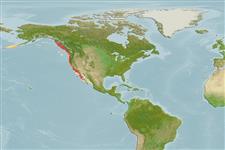
laut dasar (demersal); nir-ruaya; kisaran kedalaman 16 - 966 m (Ref. 96339). Temperate; 58°N - 20°N, 137°W - 105°W
Eastern Pacific: southeastern Alaska to Bahia San Pablo, central Baja California, Mexico.
Panjang pada saat jatuh tempo pertama / Ukuran / Berat / umur
Kematangan: Lm 42.0 range ? - ? cm
Max length : 63.5 cm TL jantan/; (Ref. 96339)
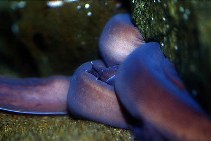
Duri punggung (Keseluruhan (total)) : 0; duri punggung lunak (Keseluruhan (total)) : 0; Duri dubur: 0; Sirip dubur lunak: 0. No true fins - one dorsal finfold, far back, median, very low, continuous with caudal; caudal broad, rounded; ventral finfold very low, origin somewhat posterior to last gill pore, extending to anus (Ref. 6885). Dark brown, tan, gray, or brownish red, often tinted with blue or purple, never black, lighter ventrally, rarely with large patches of white; preserved specimens light brown (Ref. 6885).
Body shape (shape guide): eel-like.
Inhabits fine silt and clay bottoms (Ref. 6885). Enters large fishes by way of the mouth and anus and feed on its viscera and muscles (Ref. 6885). May greatly diminish catches taken with fixed gears (Ref. 6885). Produces mucilaginous slime when harassed (Ref. 6885). Probably exhibits hermaphroditism (Ref. 56947). Due to its primitive metabolism it is collected for research purposes (Ref. 6885). TBK: demerspelag.
Copulatory organ absent (Ref. 51361). Presence of bisexual juvenile gonad, requires further investigation regarding hermaphroditism (Ref. 56947). In one study (Ref. 40710), hermaphroditism is exhibited by only 0.2% of the individuals studied.
Fernholm, B., 1998. Hagfish systematics. p. 33-44. In J.M. Jørgensen, J.P. Lomholt, R.E. Weber and H. Malte (eds.) The biology of hagfishes. Chapman & Hall, London. 578 p. (Ref. 31276)
Status IUCN Red List (Ref. 130435: Version 2025-2 (Global))
ancaman kepada manusia
Harmless
penggunaan manusia
Perikanan: tidak ada kepentingan; Akuarium: Akuarium publik
Alat, peralatan
laporan khas
muat turun XML
Sumber internet
Estimasi berdasarkan model
Suhu yang disukai (Acuan
123201): 5.8 - 9.4, mean 7.1 °C (based on 54 cells).
Indeks keanekaragaman filogenetik (Acuan
82804): PD
50 = 0.5000 [Uniqueness, from 0.5 = low to 2.0 = high].
Bayesian length-weight: a=0.00288 (0.00171 - 0.00487), b=2.88 (2.73 - 3.03), in cm total length, based on LWR estimates for this species & (Sub)family-body (Ref.
93245).
Tingkat Trofik (Acuan
69278): 4.2 ±0.70 se; based on food items.
Daya lenting (Acuan
120179): Rendah, Waktu penggandaan populasi minimum 4.5 - 14 tahun (Fec = 28).
Kerentanan Penangkapan Ikan (Ref.
59153): Moderate to high vulnerability (45 of 100).
🛈