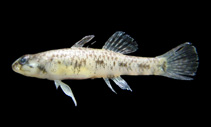
>
Gobiiformes (Gobies) >
Gobiidae (Gobies) > Gobionellinae
Etymology: Pseudogobius: Greek, pseudes = false + Latin, gobius = gudgeon (Ref. 45335).
More on author: Bleeker.
Entorno: milieu / zona climática / rango de profundidad / gama de distribución
Ecología
marino; agua dulce; salobre demersal; anfidromo (Ref. 51243). Tropical
Indo-West Pacific: western Indonesia, Malaysia, Singapore, Brunei, Thailand, Cambodia, Vietnam, Taiwan, Hong Kong, Philippines and southern Japan; west of Lydekker’s Line.
Tamaño / Peso / Edad
Madurez: Lm ? range ? - ? cm
Max length : 6.5 cm TL macho / no sexado; (Ref. 7050)
Facultative air-breathing in the genus (Ref. 126274); Found in shallow-water estuarine, estuaries of rivers, streams and mangroves, at depths of 0–1 m, especially in mangrove habitats (Ref. 126575). Adults also found in the sea (Ref. 4833). Feed on small fishes and invertebrates (Ref. 12693).
Ciclo vital y comportamiento de apareamiento
Madurez | Reproducción | Puesta | Huevos | Fecundidad | Larva
The male guards the clutch only as long as the young have not hatched.
Larson, H.K. and M.P. Hammer, 2021. A revision of the gobiid fish genus Pseudogobius (Teleostei, Gobiidae, Tridentigerinae), with description of seven new species from Australia and South-east Asia. Zootaxa 4961(1):1-85. (Ref. 126575)
Situación en la Lista Roja de la UICN (Ref. 130435: Version 2025-2 (Global))
Amenaza para el ser humano
Harmless
Usos humanos
Pesquerías: sin interés
Herramientas
Informes especiales
Descargar XML
Fuentes de Internet
Estimaciones basadas en modelos
Índice de diversidad filogenética (Referencia
82804): PD
50 = 0.5000 [Uniqueness, from 0.5 = low to 2.0 = high].
Bayesian length-weight: a=0.00708 (0.00332 - 0.01511), b=3.07 (2.89 - 3.25), in cm total length, based on LWR estimates for this (Sub)family-body shape (Ref.
93245).
Nivel trófico (Referencia
69278): 3.3 ±0.5 se; based on size and trophs of closest relatives
Resiliencia (Referencia
120179): Alto, población duplicada en un tiempo mínimo inferior a 15 meses (Preliminary K or Fecundity.).
Vulnerabilidad pesquera (Ref.
59153): Low vulnerability (10 of 100).
🛈