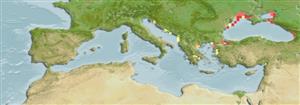
Ambiente: milieu / zona climatica / distribuzione batimetrica / gamma di distribuzione
Ecologia
marino; acqua dolce; salmastro demersale; anadromo (Ref. 131118); distribuzione batimetrica 30 - 60 m (Ref. 3397). Temperate; 10°C - 20°C (Ref. 2059); 57°N - 36°N, 14°E - 53°E
Europe: Black, Azov, Caspian and Aral Sea, ascending some rivers (Danube up to Bratislava, Volga up to Kazan, Ural up to Chkalov), unknown or very rare in others. On the verge of extinction in its natural range.
Extirpated in Aral basin; nearly extirpated in Black Sea basin; only occasional records from Danube and lower Volga; only a very small population remaining in Rivers Ural (Russia, Kazakhstan) and Rioni (Georgia); no natural spawning population in Iran; established in Lake Balkhash where it forms a large population (Ref. 59043). Artificially propagated (Ref. 6866).
Lunghezza alla prima maturità / Dimensione / Peso / Età
Maturità: Lm ? range ? - ? cm
Max length : 211 cm TL maschio/sesso non determinato; (Ref. 98365); common length : 132 cm TL maschio/sesso non determinato; (Ref. 3397); peso massimo pubblicato: 80.0 kg (Ref. 52332); Età massima riportata: 30 anni (Ref. 796)
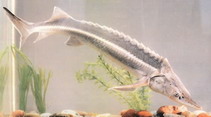
Spine dorsali (totale) : 0; Raggi dorsali molli (totale) : 45 - 57; Raggi anali molli: 23 - 37. Snout moderately long and pointed at tip. Lower lip continuous, not interrupted at centre. Barbels halfway between tip of snout and mouth, reaching the latter. Five rows of scutes, dorsal 11-17, lateral 49-70, but usually 55-56 on each side, ventral 10-16, with no smaller plates between dorsal and ventral rows. Color of back grey, flanks lighter, belly white.
Body shape (shape guide): elongated; Cross section: circular.
Adults occur in the sea close to shores and estuaries and in deep stretches of large rivers over muddy substrate. Are usually solitary. Juveniles live in shallow riverine habitats (Ref. 59043). Feed on mollusks, amphipods and chironomid larvae. Spawning takes place in strong-current habitats in main course of large and deep rivers on stone or gravel bottom (Ref. 59043) from end of April to June (end of May in Rioni River, Black Sea) (Ref. 3193).
Most juveniles move to sea in their first summer and remain there until they reach maturity. Others remain for a longer period. In autumn, individuals migrate to the rivers and remain there until the following spring to spawn (Ref. 59043). Females reproduce every 2-3 and males every 1-2 years (Ref. 59043).
Bauchot, M.-L., 1987. Poissons osseux. p. 891-1421. In W. Fischer, M.L. Bauchot and M. Schneider (eds.) Fiches FAO d'identification pour les besoins de la pêche. (rev. 1). Méditerranée et mer Noire. Zone de pêche 37. Vol. II. Commission des Communautés Européennes and FAO, Rome. (Ref. 3397)
Stato della Lista Rossa IUCN (Ref. 130435: Version 2025-2 (Global))
Minaccia per l'uomo
Harmless
Usi umani
Pesca: commerciale; Acquacoltura: commerciale
Strumenti
Rapporti speciali
Scarica XML
Fonti Internet
Stime basate su modelli
Temperatura preferita (Fonte Biblio.
123201): 7.7 - 11.1, mean 10.4 °C (based on 9 cells).
Indice di diversità filogenetica (Fonte Biblio.
82804): PD
50 = 0.5000 [Uniqueness, from 0.5 = low to 2.0 = high].
Bayesian length-weight: a=0.00562 (0.00345 - 0.00916), b=3.19 (3.06 - 3.32), in cm total length, based on LWR estimates for this species & Genus-body shape (Ref.
93245).
Livello trofico (Fonte Biblio.
69278): 3.3 ±0.45 se; based on food items.
Resilienza (Fonte Biblio.
120179): Basso, tempo minimo di raddoppiamento della popolazione 4.5 - 14 anni (K=0.04-0.12; tmax=30; Fec=165,000).
Vulnerabilità della pesca (Ref.
59153): Very high vulnerability (85 of 100).
🛈