Environnement : milieu / zone climatique / profondeur / gamme de distribution
Écologie
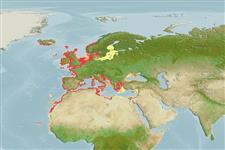
marin; eau douce; saumâtre démersal; catadrome (Ref. 46888); profondeur 2 - 15 m (Ref. 130217). Subtropical; 65°N - 12°N, 24°W - 36°E
Eastern Atlantic Ocean: from Iceland, the Faroe Islands, and southern Norway to the Cape Verde archipelago; the Azores archipelago appears to be the westernmost limit of its range; the Mediterranean and Black Sea basins.
Longueur à la première maturité / Taille / Poids / Âge
Maturité: Lm 29.5 range ? - ? cm
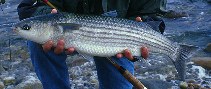
Max length : 75.0 cm SL mâle / non sexé; (Ref. 35388); common length : 32.0 cm SL mâle / non sexé; (Ref. 7399); poids max. publié: 4.5 kg (Ref. 35388); âge max. reporté: 25 années (Ref. 35388)
Épines dorsales (Total) : 5; Rayons mous dorsaux (Total) : 7 - 9; Épines anales: 3; Rayons mous anaux: 8 - 9.
Body shape (shape guide): elongated.
Adults are found inshore in schools, frequently entering brackish lagoons and freshwater (Ref. 30578). They migrate occasionally tending to move northward in summer-time as temperatures rise. Females are larger than males (Ref. 59043). Adults feed mainly on benthic diatoms, epiphytic algae, small invertebrates and detritus (Ref. 2804), juveniles only feed on zooplankton (Ref. 59043). Oviparous (Ref. 205). Reproduction occurs in the sea during winter (Ref. 30578). Eggs and larvae pelagic. Utilized as a food fish (Ref. 4645).
Juveniles around 2.0 cm SL move to coastal lagoons and estuaries in April-June and return to sea in summer (Ref. 59043).
Thomson, J.M., 1986. Mugilidae. p. 344-349. In J. Daget, J.-P. Gosse and D.F.E. Thys van den Audenaerde (eds.) Check-list of the freshwater fishes of Africa (CLOFFA). ISNB, Brussels, MRAC; Tervuren; and ORSTOM, Paris. Vol. 2. (Ref. 3573)
Statut dans la liste rouge de l'IUCN (Ref. 130435: Version 2025-2 (Global))
Menace pour l'homme
Harmless
Utilisations par l'homme
Pêcheries: commercial; pêche sportive: oui; Aquarium: Aquariums publics
Outils
Articles particuliers
Télécharger en XML
Sources Internet
Estimations basées sur des modèles
Température préférée (Réf.
123201): 8.8 - 20.1, mean 11 °C (based on 420 cells).
Indice de diversité phylogénétique (Réf.
82804): PD
50 = 0.5010 [Uniqueness, from 0.5 = low to 2.0 = high].
Bayesian length-weight: a=0.00724 (0.00561 - 0.00935), b=3.11 (3.03 - 3.19), in cm total length, based on LWR estimates for this species (Ref.
93245).
Niveau trophique (Réf.
69278): 2.6 ±0.32 se; based on food items.
Résilience (Réf.
120179): Faible, temps minimum de doublement de population : 4,5 à 14 années (K=0.12-0.3; tm=3; tmax=25).
Vulnérabilité de la pêche (Ref.
59153): High vulnerability (63 of 100).
🛈
Vulnérabilité climatique (Ref.
125649): Moderate to high vulnerability (51 of 100).
🛈
Nutriments (Ref.
124155): Calcium = 39.2 [10.7, 335.3] mg/100g; Iron = 0.623 [0.303, 1.151] mg/100g; Protein = 17.9 [16.5, 19.5] %; Omega3 = 0.399 [0.166, 0.964] g/100g; Selenium = 9.58 [3.60, 24.88] μg/100g; VitaminA = 7.52 [2.12, 24.93] μg/100g; Zinc = 0.571 [0.342, 0.951] mg/100g (wet weight); based on
nutrient studies.