>
Ophidiiformes (Cusk eels) >
Carapidae (Pearlfishes) > Carapinae
Etymology: Eurypleuron: Greek, eurys = long + Greek, pleura = near, the side of (Ref. 45335); owasianum: Named for its type locality (Ref. 5275).
Umwelt: Milieu / Klimazone / Tiefenbereich / Verbreitungsgebiet
Ökologie
seewasser bathydemersal; tiefenbereich 1 - 455 m (Ref. 34024). Deep-water
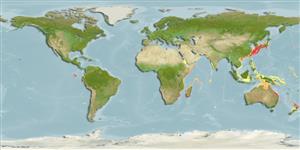
Northwest Pacific: Japan. Pending a comprehensive study of the group, E. owasianum is restricted to Japan and tentatively refer all of the disjunct southern populations to E. cinereum, the only species name available for the complex.
Größe / Gewicht / Alter
Geschlechtsreife: Lm ? range ? - ? cm
Max length : 23.6 cm TL Männchen/unbestimmt; (Ref. 5275)
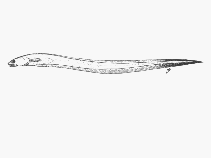
Eel-like, shallow body depth; dorsal fin origin about opposite anal fin origin; males with expanded parapophyses on vertebrae 5 to 18-20; lacking cardiform premaxillary teeth, pelvic fins, swim bladder rocker bone, and ventral tunic ridges on posterior swim bladder (Ref. 34024).
Body shape (shape guide): eel-like.
Uncommon species (Ref. 34024). Presumably free-living (Ref. 34024).
Lebenszyklus und Paarungsverhalten
Geschlechtsreife | Fortpflanzung | Ablaichen | Eier | Fruchtbarkeit | Larven
Nielsen, J.G., D.M. Cohen, D.F. Markle and C.R. Robins, 1999. Ophidiiform fishes of the world (Order Ophidiiformes). An annotated and illustrated catalogue of pearlfishes, cusk-eels, brotulas and other ophidiiform fishes known to date. FAO Fish. Synop. 125(18):178p. Rome: FAO. (Ref. 34024)
IUCN Rote Liste Status (Ref. 130435: Version 2025-2 (Global))
Bedrohung für Menschen
Harmless
Nutzung durch Menschen
Fischereien: nicht kommerziell
Tools
Zusatzinformationen
Download XML
Internet Quellen
Schätzungen auf der Grundlage von Modellen
Bevorzugte Temperatur (Ref.
123201): 14.1 - 23.8, mean 19.3 °C (based on 180 cells).
Phylogenetischer Diversitätsindex (Ref.
82804): PD
50 = 0.7500 [Uniqueness, from 0.5 = low to 2.0 = high].
Bayesian length-weight: a=0.00102 (0.00046 - 0.00225), b=3.06 (2.88 - 3.24), in cm total length, based on all LWR estimates for this body shape (Ref.
93245).
Trophische Ebene (Ref.
69278): 3.6 ±0.5 se; based on size and trophs of closest relatives
Anfälligkeit der Fischerei (Ref.
59153): Low vulnerability (14 of 100).
🛈