>
Ophidiiformes (Cusk eels) >
Ophidiidae (Cusk-eels) > Neobythitinae
Etymology: Pycnocraspedum: Greek, pyknos = dense + Greek, kraspedon = border (Ref. 45335).
More on author: Alcock.
Entorno: milieu / zona climática / rango de profundidad / gama de distribución
Ecología
marino bentopelágico; rango de profundidad 200 - 500 m (Ref. 31524). Deep-water
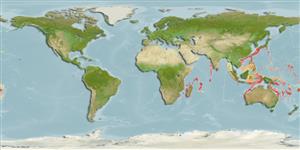
Indo-West Pacific: off East Africa to New Caledonia.
Tamaño / Peso / Edad
Madurez: Lm ? range ? - ? cm
Max length : 29.9 cm SL macho / no sexado; (Ref. 124036)
Descripción breve
Claves de identificación | Morfología | Morfometría
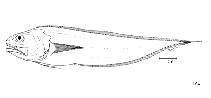
Radios blandos dorsales (total) : 63 - 92; Radios blandos anales: 54 - 79; Vértebra: 47 - 49. A deep bodied cusk eel distinguished by the following characters: head 3.0-3.9 times in SL; eye diameter 5.5-6.8 in HL; interorbital 4.8-6.3 in HL; snout 3.8-5.2 in HL; depth 4.3-6.8 in SL; predorsal length 3.3-4.7 in SL, with distance between pelvic origin to anal origin 2.5-4.4 in SL; absence of pseudobranchiae; pyloric caeca 12-13; median basibranchial tooth patches 2; one opercular spine and 3 short blunt spines at the lower angle of preopercle; differs from its congeners in origin of dorsal fin which is above preopercle, no pseudobranchial filaments, pectoral fins and pelvic fins are short and not reaching anus (Ref. 124036)
Body shape (shape guide): elongated; Cross section: compressed.
A benthic species found on the continental slope (Ref. 75154). Uncommon species (Ref. 34024). Oviparous, with oval pelagic eggs floating in a gelatinous mass (Ref. 205).
Ciclo vital y comportamiento de apareamiento
Madurez | Reproducción | Puesta | Huevos | Fecundidad | Larva
Nielsen, J.G., D.M. Cohen, D.F. Markle and C.R. Robins, 1999. Ophidiiform fishes of the world (Order Ophidiiformes). An annotated and illustrated catalogue of pearlfishes, cusk-eels, brotulas and other ophidiiform fishes known to date. FAO Fish. Synop. 125(18):178p. Rome: FAO. (Ref. 34024)
Situación en la Lista Roja de la UICN (Ref. 130435: Version 2025-2 (Global))
Amenaza para el ser humano
Harmless
Usos humanos
Pesquerías: sin interés
Herramientas
Informes especiales
Descargar XML
Fuentes de Internet
Estimaciones basadas en modelos
Temperatura preferida (Referencia
123201): 11.1 - 18.8, mean 13.5 °C (based on 131 cells).
Índice de diversidad filogenética (Referencia
82804): PD
50 = 0.5312 [Uniqueness, from 0.5 = low to 2.0 = high].
Bayesian length-weight: a=0.01995 (0.00906 - 0.04395), b=3.01 (2.83 - 3.19), in cm total length, based on all LWR estimates for this body shape (Ref.
93245).
Nivel trófico (Referencia
69278): 3.6 ±0.6 se; based on size and trophs of closest relatives
Resiliencia (Referencia
120179): Medio, población duplicada en un tiempo mínimo de 1.4-4.4 años (Preliminary K or Fecundity.).
Vulnerabilidad pesquera (Ref.
59153): Low to moderate vulnerability (26 of 100).
🛈