>
Salmoniformes (Salmons) >
Salmonidae (Salmonids) > Salmoninae
Etymology: Salvelinus: Old name for char; it is the same root of german "saibling" = little salmon (Ref. 45335).
More on author: Walbaum.
Entorno: milieu / zona climática / rango de profundidad / gama de distribución
Ecología
; agua dulce bentopelágico; potamodromo (Ref. 126106); rango de profundidad 3 - 61 m (Ref. 120394), usually 18 - 53 m (Ref. 1998). Temperate; 4°C - 13°C (Ref. 120394); 75°N - 38°N, 168°W - 67°W (Ref. 86798)
North America: Atlantic, Arctic, and Pacific basins from northern Canada and Alaska south to New England in USA, Great Lakes, and northern Montana, USA. Introduced widely to many areas outside its native range.
Splakes (hybrid between Salvelinus namaycush and Salvelinus fontinalis) have also been successfully introduced to many areas of North America. The three observed phenotypes existing in Lake Superior (lean, siscowet and humper or paperbelly) are under some genetic control and not merely expressions of environmental adaptation (Ref. 40529).
Longitud en la primera madurez / Tamaño / Peso / Edad
Madurez: Lm 51.6, range 42 - 50 cm
Max length : 150 cm TL macho / no sexado; (Ref. 40637); common length : 50.0 cm TL macho / no sexado; (Ref. 6114); peso máximo publicado: 32.7 kg (Ref. 40637); edad máxima reportada: 50 años (Ref. 3494)
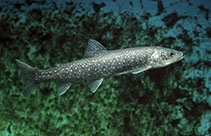
Espinas dorsales (total) : 4 - 5; Radios blandos dorsales (total) : 8 - 10; Espinas anales: 4 - 5; Radios blandos anales: 8 - 10; Vértebra: 61 - 69. Distinguished by its color, white or yellowish spots on a dark green to grayish background, its deeply forked tail and its numerous pyloric caeca. Lateral line slightly curved anteriorly; pelvic fins with small axillary process (Ref. 27547). Body typically trout-like, elongate, somewhat rounded. Head stout, broad dorsally; mouth large, terminal, snout usually protruding slightly beyond lower jaw when mouth is closed. Back and sides usually dark green liberally sprinkled with whitish to yellowish (never pink or red) spots; overall color varies from light green to gray, brown, dark green or nearly black; belly white; pale spots present on dorsal, adipose and caudal fins and usually on base of anal; sometimes orange-red on paired fins, especially in northern populations; anterior edge of paired and anal fins sometimes with a white border. At spawning time, males develop a dark lateral stripe and become paler on the back (Ref. 27547). Caudal fin with 19 rays (Ref. 2196). Distinguished from congeners in Europe by the unique dark brown head, body, dorsal and caudal fins, covered by small pale spots; differs also by its deeply forked caudal fin (Ref. 59043).
Body shape (shape guide): fusiform / normal; Cross section: oval.
Adults ocur in shallow and deep waters of northern lakes and streams and is restricted to relatively deep lakes in the southern part of its range (Ref. 5723, 86798). Rarely found in brackish water (Ref. 11980). A solitary wanderer, the extent of their movements apparently limited by the size of the lake and individual (Ref. 27547). Although lake trout generally feed on a variety of organisms such as freshwater sponges, crustaceans, insects, fishes (with a preference for ciscoes), and small mammals, some populations feed on plankton throughout their lives (Ref. 27547). Such plankton-feeding lake trout grow more slowly, mature earlier and at smaller size, die sooner and attain smaller maximum size than do their fish-eating counterparts (Ref. 30351). Lake trout are highly susceptible to pollution, especially from insecticides (Ref. 14019, 27547). Utilized as a food fish, its flesh is usually of a yellow or creamy color but may be anything from white to orange (Ref. 27547). Often caught by fishers (Ref. 30578).
The spawning act occurs mostly at night, with peak activity between dusk and 9 or 10 pm (Ref. 28805, 28815). During the day the fish are more or less dispersed away from the spawning beds but return in considerable numbers in the late afternoon (Ref. 27547). Males reach spawning beds first and spend some time cleaning the rocks. Females arrive a few days later and are courted by the males. During and following courtship, the males attempt to spawn with the females. One or two males approach a female, press against her sides and quiver. The eggs fall into the crevices and the spawners disperse. The act is repeated until the female releases all her eggs (Ref. 1998, 27547). On occasion, as many as seven males and three females may engage in a mass spawning act (Ref. 28815). Spawning occurs annually in southern areas, every other year in Great Slave Lake, Northwest Terrritories, and only every other year in Great Bear and some other lakes of the arctic (Ref. 1153, 28802, 28860).
Page, L.M. and B.M. Burr, 2011. A field guide to freshwater fishes of North America north of Mexico. Boston : Houghton Mifflin Harcourt, 663p. (Ref. 86798)
Situación en la Lista Roja de la UICN (Ref. 130435: Version 2025-2 (Global))
Amenaza para el ser humano
Harmless
Usos humanos
Pesquerías: comercial; Acuicultura: comercial; pesca deportiva: si
Herramientas
Informes especiales
Descargar XML
Fuentes de Internet
Estimaciones basadas en modelos
Índice de diversidad filogenética (Referencia
82804): PD
50 = 0.5000 [Uniqueness, from 0.5 = low to 2.0 = high].
Bayesian length-weight: a=0.00832 (0.00711 - 0.00974), b=3.02 (2.98 - 3.06), in cm total length, based on LWR estimates for this species (Ref.
93245).
Nivel trófico (Referencia
69278): 4.3 ±0.5 se; based on diet studies.
Generation time: 6.5 (4.4 - 9.1) years. Estimated as median ln(3)/K based on 32
growth studies.
Resiliencia (Referencia
120179): Bajo, población duplicada en un tiempo mínimo de 4.5-14 años (K=0.05-0.12; tm=5-20; tmax=50; Fec=5,000).
Vulnerabilidad pesquera (Ref.
59153): High vulnerability (65 of 100).
🛈
Nutrientes (Ref.
124155): Calcium = 5.7 [3.5, 10.8] mg/100g; Iron = 0.366 [0.232, 0.579] mg/100g; Protein = 18.5 [17.1, 20.0] %; Omega3 = 1.71 [0.52, 5.82] g/100g; Selenium = 17.6 [5.5, 58.3] μg/100g; VitaminA = 31.9 [8.9, 117.6] μg/100g; Zinc = 0.573 [0.428, 0.819] mg/100g (wet weight); based on
nutrient studies.