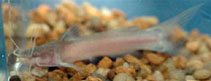
Entorno: milieu / zona climática / rango de profundidad / gama de distribución
Ecología
; agua dulce bentopelágico. Tropical
Asia: Pakistan to Thailand.
Tamaño / Peso / Edad
Madurez: Lm ? range ? - ? cm
Max length : 12.5 cm SL macho / no sexado; (Ref. 4833)
Descripción breve
Claves de identificación | Morfología | Morfometría
Differs from A. mucronatum, A. murraystuarti, A. platycephalus, A. foratum and A. variegatum in having a relatively short body with 34-36 (versus 38-40) vertebrae, and a caudal fin with upper and lower lobes fo distinctly different shapes (versus truncate caudal fin in A. murraystuarti and with both lobes similar in shape in other Indochinese species). Pectoral spine smooth (Ref. 37785).
Body shape (shape guide): elongated.
Occurs in pebbly beds in swift currents at the base of hills (Ref. 4833). Found among rocks and boulders on the bottom of fast flowing upland streams. Diet consists of aquatic insects. Not seen in markets (Ref. 12693).
Ciclo vital y comportamiento de apareamiento
Madurez | Reproducción | Puesta | Huevos | Fecundidad | Larva
Talwar, P.K. and A.G. Jhingran, 1991. Inland fishes of India and adjacent countries. Volume 2. A.A. Balkema, Rotterdam, i-xxii + 543-1158, 1 pl. (Ref. 4833)
Situación en la Lista Roja de la UICN (Ref. 130435: Version 2025-2 (Global))
Amenaza para el ser humano
Harmless
Usos humanos
Pesquerías: sin interés
Herramientas
Informes especiales
Descargar XML
Fuentes de Internet
Estimaciones basadas en modelos
Índice de diversidad filogenética (Referencia
82804): PD
50 = 0.5000 [Uniqueness, from 0.5 = low to 2.0 = high].
Bayesian length-weight: a=0.00603 (0.00351 - 0.01036), b=3.00 (2.85 - 3.15), in cm total length, based on LWR estimates for this species & (Sub)family-body (Ref.
93245).
Nivel trófico (Referencia
69278): 3.2 ±0.40 se; based on food items.
Vulnerabilidad pesquera (Ref.
59153): Low vulnerability (10 of 100).
🛈