>
Lophiiformes (Anglerfishes) >
Himantolophidae (Footballfishes)
Etymology: Himantolophus: Greek, himas or himantos = leather strap, thong or leash (referring to the thick leathery illicium) + Greek, lopho or lophio = crest or tuft (referring to the baited illicium projecting from the head) (Ref. 86949).
Eponymy: Mr. Appel of Hokitika, New Zealand. In a transcript of a paper read before the Westland Institute (1877), Clarke thanks “…Mr. Appel, V.S., of this town, to whom this last fish was sent by its collector, and who has kindly allowed me to figure and [...] (Ref. 128868), visit book page.
Meio ambiente: milieu / Zona climática / intervalo de profundidade / faixa de distribuição
Ecologia
marinhas batipelágico; intervalo de profundidade 338 - 1360 m (Ref. 86949). Deep-water
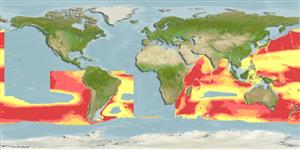
Circumglobal in the southern hemisphere except eastern Pacific (Ref. 7300). Range extended to the Falkland Is. (Ref. 80772) and probably a first record in the Philippines (Ref. 95664).
Tamanho / Peso / Idade
Maturidade: Lm ? range ? - ? cm
Max length : 40.0 cm TL macho/indeterminado; (Ref. 33839)
Descrição suscinta
Chaves de identificação | Morfologia | Morfometria
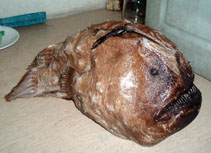
Raios dorsais (total) : 5; Raios anais : 4. This species is distinguished in having the illicium with a bulbous distal light organ, originating from behind the tip of the snout; external second cephalic ray absent; esca without bony denticles; posterior appendage present, bifurcated at the base and each primary branch had a side branch near the base; distal appendage absent (Ref. 80772). Metamorphosed females characterized further by having a series of 2-7 filaments emerging from the anterior margin of the 2 primary branches of paired posterior escal appendage; posterolateral appendages simple or bifurcated at tip, longest is less than 10% SL in specimens less than 10 cm; presence of small dermal spinules on stem of illicium, escal bulb and escal appendages in specimens greater than 3 cm; low and indistinct papillae of snout and chin; skin devoid of white patches; caudal fin rays white or faintly pigmented in specimens less than 10 cm. Adult males with 11-13 olfactory lamellae; diameter of posterior nostril 5.7-6.7% SL, length of snout 17-18% SL; presence of about 20-25 upper denticular teeth and 22-32 lower denticular teeth (Ref. 86949).
Body shape (shape guide): short and / or deep.
Mesopelagic species (Ref. 7300).
Ciclo de vida ou comportamento de acasalamento
Maturidade | Reprodução | Desova | Ovos | Fecundidade | Larvas
Paxton, J.R., D.F. Hoese, G.R. Allen and J.E. Hanley, 1989. Pisces. Petromyzontidae to Carangidae. Zoological Catalogue of Australia, Vol. 7. Australian Government Publishing Service, Canberra, 665 p. (Ref. 7300)
Status na Lista Vermelha da UICN (Ref. 130435: Version 2025-2 (Global))
Ameaça para os humanos
Harmless
Uso pelos humanos
Ferramentas
Relatórios especiais
Baixar XML
Fontes da internet
Estimativas baseadas em modelos
Temperatura preferida (Ref.
123201): 2.3 - 10, mean 7.1 °C (based on 612 cells).
Índice de diversidade filogenética (Ref.
82804): PD
50 = 0.5000 [Uniqueness, from 0.5 = low to 2.0 = high].
Bayesian length-weight: a=0.01995 (0.00906 - 0.04395), b=3.01 (2.83 - 3.19), in cm total length, based on all LWR estimates for this body shape (Ref.
93245).
Nível Trófico (Ref.
69278): 4.0 ±0.70 se; based on food items.
Vulnerabilidade da pesca (Ref.
59153): Low to moderate vulnerability (30 of 100).
🛈