Klassifizierung / Names
Namen | Synonyme | Catalog of Fishes(Gattung, Arten) | ITIS | CoL | WoRMS | Cloffa
>
Siluriformes (Catfishes) >
Ailiidae (Asian schilbeids)
Etymology: Clupisoma: Latin, clupea = sardine, derived from Clupeus = shield; doubtless a reference to the sacles covering the body of the fish + Greek, soma = body (Ref. 45335).
Eponymy: Stanley Henry Prater (1890–1960) was an Indian-born British naturalist. [...] (Ref. 128868), visit book page.
More on author: Hora.
Umwelt: Milieu / Klimazone / Tiefenbereich / Verbreitungsgebiet
Ökologie
; süßwasser demersal. Tropical
Asia: widely distributed in the lower and middle reaches of the Irrawaddy River, the lower reaches of the Salween River, and the Bago and Sittang rivers of Myanmar.
Größe / Gewicht / Alter
Geschlechtsreife: Lm ? range ? - ? cm
Max length : 27.0 cm TL Männchen/unbestimmt; (Ref. 4833)
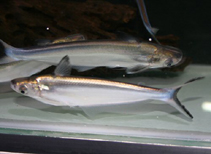
Rückenflossenstacheln (insgesamt) : 2; Rückenflossenweichstrahlen (insgesamt) : 7; Afterflossenstacheln: 0; Afterflossenweichstrahlen: 41 - 46; Wirbelzahl: 48 - 50. A species of Clupisoma in which the pectoral spine extends at least to the base of the pelvic fin, the abdomen is markedly keeled from the level of the pectoral-fin origin to the anus, pectoral fin with 12 or 13 segmented rays, anal fin with 37 to 41 branched rays, and first gill arch with at least 20 rakers. The body is silvery, except for a dorsal greenish band that extends only slightly ventral of the middorsal line of the body. D. II, 7; A. iv-v, 37-41; Pt. I, 12-13; Pv. i, 5. Barbels in four pairs: one pair of nasal barbels, one pair of axillary barbels, two pairs of mental barbels, and one pair of inner mental barbels.
Body shape (shape guide): elongated; Cross section: compressed.
Oviparous, eggs are unguarded (Ref. 205).
Lebenszyklus und Paarungsverhalten
Geschlechtsreife | Fortpflanzung | Ablaichen | Eier | Fruchtbarkeit | Larven
Distinct pairing (Ref. 205).
Ferraris, C.J. Jr., 2004. A new species of the Asian schilbid catfish genus Clupisoma from Myanmar, with a redescription of Clupisoma prateri Hora (Osteichthyes: Siluriformes: Schilbidae). Zootaxa 437:1-10. (Ref. 51091)
IUCN Rote Liste Status (Ref. 130435: Version 2025-2 (Global))
Bedrohung für Menschen
Harmless
Nutzung durch Menschen
Fischereien: nicht kommerziell
Tools
Zusatzinformationen
Download XML
Internet Quellen
Schätzungen auf der Grundlage von Modellen
Phylogenetischer Diversitätsindex (Ref.
82804): PD
50 = 0.5010 [Uniqueness, from 0.5 = low to 2.0 = high].
Bayesian length-weight: a=0.00537 (0.00245 - 0.01178), b=3.06 (2.87 - 3.25), in cm total length, based on LWR estimates for this (Sub)family-body shape (Ref.
93245).
Trophische Ebene (Ref.
69278): 3.5 ±0.6 se; based on size and trophs of closest relatives
Widerstandsfähigkeit (Ref.
120179): hoch, Verdopplung der Population dauert weniger als 15 Monate. (Preliminary K or Fecundity.).
Anfälligkeit der Fischerei (Ref.
59153): Low vulnerability (17 of 100).
🛈