>
Lophiiformes (Anglerfishes) >
Histiophrynidae (Starfingered frogfishes)
Etymology: Echinophryne: Greek, echinos = sea urchin, hedgehog + Greek, phryne = toad (Ref. 45335).
Eponymy: Lewis C ‘Lou’ Reynolds of Melbourne collected the holotype (1983) and a paratype in southern Australia. We have no further details of him. (Ref. 128868), visit book page.
Umwelt: Milieu / Klimazone / Tiefenbereich / Verbreitungsgebiet
Ökologie
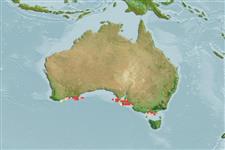
seewasser riff-verbunden; tiefenbereich 0 - 20 m (Ref. 57178). Temperate; 34°S - 40°S, 116°E - 147°E (Ref. 57382)
Indo-Pacific: Endemic to Australia.
Größe / Gewicht / Alter
Geschlechtsreife: Lm ? range ? - ? cm
Max length : 8.0 cm TL Männchen/unbestimmt; (Ref. 33839)
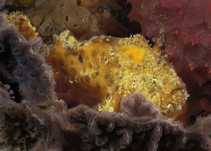
A benthic species (Ref. 75154) which occurs inshore (Ref. 7300, 75154); associated with sponges (Ref. 75154).
Lebenszyklus und Paarungsverhalten
Geschlechtsreife | Fortpflanzung | Ablaichen | Eier | Fruchtbarkeit | Larven
Oviparous.
Paxton, J.R., D.F. Hoese, G.R. Allen and J.E. Hanley, 1989. Pisces. Petromyzontidae to Carangidae. Zoological Catalogue of Australia, Vol. 7. Australian Government Publishing Service, Canberra, 665 p. (Ref. 7300)
IUCN Rote Liste Status (Ref. 130435: Version 2025-2 (Global))
Bedrohung für Menschen
Harmless
Nutzung durch Menschen
Tools
Zusatzinformationen
Download XML
Internet Quellen
Schätzungen auf der Grundlage von Modellen
Bevorzugte Temperatur (Ref.
123201): 15.2 - 18.4, mean 16.8 °C (based on 107 cells).
Phylogenetischer Diversitätsindex (Ref.
82804): PD
50 = 0.6250 [Uniqueness, from 0.5 = low to 2.0 = high].
Bayesian length-weight: a=0.01000 (0.00244 - 0.04107), b=3.04 (2.81 - 3.27), in cm total length, based on all LWR estimates for this body shape (Ref.
93245).
Trophische Ebene (Ref.
69278): 3.6 ±0.5 se; based on size and trophs of closest relatives
Widerstandsfähigkeit (Ref.
120179): hoch, Verdopplung der Population dauert weniger als 15 Monate. (Fec assumed to be > 10,000).
Anfälligkeit der Fischerei (Ref.
59153): Low vulnerability (10 of 100).
🛈