>
Lophiiformes (Anglerfishes) >
Brachionichthyidae (Handfishes)
Etymology: Thymichthys: Greek thymos (warty excrescence) and Greek ichthys (fish) in allusion to the warty protuberances on the skin of these handfishes; verrucosus: Name presumably based on the Latin 'verrucosus' meaning full of warts, referring to the obvious warty nature of its skin (Ref. 82446).
More on authors: McCulloch & Waite.
Meio ambiente: milieu / Zona climática / intervalo de profundidade / faixa de distribuição
Ecologia
marinhas demersal. Temperate
Eastern Indian Ocean: known only from South Australia.
Tamanho / Peso / Idade
Maturidade: Lm ? range ? - ? cm
Max length : 9.3 cm TL macho/indeterminado; (Ref. 82446)
Descrição suscinta
Chaves de identificação | Morfologia | Morfometria
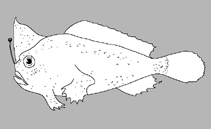
This species is distinguished by the following set of characters: esca is variable in size, length 23-57% (mean 37%) of illicium length (including esca); short to moderately elongate illicium, not thick and fleshy, without dermal spinules, length 15-27% SL, 1.9-3.4 times in head length, its base adjacent upper jaw (pre-illicial length 1.2-3.2% SL); small eye, its diameter 4.8-7.1 times in head length; body is usually densely covered with prominent, close-set, globular or fleshy warts; skin with small, widely spaced, embedded, spiny scales and variably developed dermal flaps; unicuspid or bicuspid spinules, prostrate, their tips embedded or barely visible); second dorsal-fin rays 14-18 (mainly 16-17), fin base length 60-73 (mean 66)% SL; length of second dorsal-fin spine 1.1-1.6 times length of longest ray of second dorsal fin; anal-fin rays 6-9; pectoral-fin rays usually 8; body brownish with lighter and darker blotches and spots; blackish bar on caudal peduncle and caudal-fin base that extends onto hind parts of dorsal and anal fins (Ref. 82446).
Body shape (shape guide): elongated.
A benthic species (Ref. 75154) which occurs in inshore waters (Ref. 7300, 75154) of the continental shelf (Ref. 75154).
Ciclo de vida ou comportamento de acasalamento
Maturidade | Reprodução | Desova | Ovos | Fecundidade | Larvas
Last, P. and D.C. Gledhill, 2009. A revision of the Australian handfishes (Lophiiformes: Brachionichthyidae), with descriptions of three new genera and nine new species. Zootaxa 2252:1-77. (Ref. 82446)
Status na Lista Vermelha da UICN (Ref. 130435: Version 2025-2 (Global))
Ameaça para os humanos
Harmless
Uso pelos humanos
Ferramentas
Relatórios especiais
Baixar XML
Fontes da internet
Estimativas baseadas em modelos
Índice de diversidade filogenética (Ref.
82804): PD
50 = 0.7501 [Uniqueness, from 0.5 = low to 2.0 = high].
Bayesian length-weight: a=0.00437 (0.00164 - 0.01162), b=3.12 (2.89 - 3.35), in cm total length, based on LWR estimates for this (Sub)family-body shape (Ref.
93245).
Nível Trófico (Ref.
69278): 3.6 ±0.5 se; based on size and trophs of closest relatives
Vulnerabilidade da pesca (Ref.
59153): Low vulnerability (10 of 100).
🛈