>
Salmoniformes (Salmons) >
Salmonidae (Salmonids) > Salmoninae
Etymology: Salvelinus: Old name for char; it is the same root of german "saibling" = little salmon (Ref. 45335).
More on author: Linnaeus.
Taxonomic Remarks
The species Salvelinus aureolus Bean, 1887 is considered as valid in Eschmeyer (CofF ver. May 2011: Ref. 86870) following Fuller et al. (1999: Ref. 87253). Treated as synonym of Salvelinus alpinus oquassa by Qadi (1974: Ref. 87252); and probably a synonym of Salvelinus alpinus (see Nelson et al. 2004: Ref. 52299 for taxonomic issues). Please send references, or more studies are needed.
Entorno: milieu / zona climática / rango de profundidad / gama de distribución
Ecología
marino; agua dulce; salobre bentopelágico; anadromo (Ref. 138280); rango de profundidad 0 - 70 m (Ref. 30578), usually 0 - 1 m (Ref. 101587). Temperate; 4°C - 16°C (Ref. 2059); 82°N - 41°N, 180°W - 180°E (Ref. 117475)
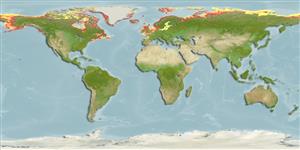
Europe and North America: Circumpolar (Ref. 86798). Iceland, Scandinavia, northern Russia (absent in rivers draining to Baltic and White Seas), Jan Mayen, Spitzberg, Kolguev, Bear and New Zemblia islands, northern Siberia, Alaska, Canada and Greenland; absent in the Alps (Ref. 59043). North America: coastal areas in Atlantic, Arctic and Pacific drainages from Newfoundland and Labrador in Canada to Alaska; south along Alantic Slope to Maine, USA (Ref. 86798). Landlocked populations in Quebec, Canada and in Maine and New Hampshire in USA (Ref. 7251).
Longitud en la primera madurez / Tamaño / Peso / Edad
Madurez: Lm 60.0 range ? - ? cm
Max length : 107 cm TL macho / no sexado; (Ref. 40637); common length : 40.0 cm TL macho / no sexado; (Ref. 4779); peso máximo publicado: 15.0 kg (Ref. 4779); edad máxima reportada: 40 años (Ref. 46974)
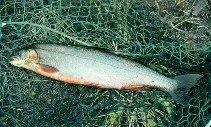
Espinas dorsales (total) : 4 - 5; Radios blandos dorsales (total) : 8 - 16; Espinas anales: 3 - 4; Radios blandos anales: 7 - 15; Vértebra: 62 - 68. Distinguished by the presence of 23 to 32 gill rakers, 37 to 75 pyloric caeca and, on the sides and back, pink to red spots, the largest of which are usually larger than the pupil of the eye (Ref. 27547). Lateral line curves slightly downward from the head (Ref. 27547). Pelvic fins with axillary process; caudal emarginate (Ref. 27547). Color highly variable, depending on location, time of year and degree of sexual development. In general, back is dark, usually rather brown but sometimes with a green cast; the sides are lighter, belly pale; sides and back are liberally sprinkled with pink to red spots, the largest spots along the lateral line usually larger than the pupil of the eye; forward edges of pectoral, pelvic and anal fins, and sometimes the caudal, with a narrow white margin; fins pale in young, dorsal and caudal dark in adults (Ref. 27547). Spawning adults, especially males, are brilliant orange-red to bright red on the ventral side and on the pectoral, pelvic and anal fins. Young have about 11 dark parr marks on each side (Ref. 27547). Caudal fin with 19 rays (Ref. 2196).
Body shape (shape guide): fusiform / normal.
Nerito-pelagic (Ref. 58426). Adults occur in the sea along coasts, estuaries, rivers, and lakes with cold, clear water (Ref. 59043). They are found in deep runs and pools of medium to large rivers (Ref. 5723, 86798). Anadromous forms spend a considerable time of their lives at sea; non-migratory populations remain in lakes and rivers (Ref. 4779). Anadromous populations enter rivers to breed during fall and winter (Ref. 86798). Freshwater populations feed on planktonic crustaceans, amphipods, mollusks, insects and fishes (Ref. 4479). Anadromous individuals feed little in freshwater and never feed during migrations. Spawning usually takes place on pebble to stone bottom in lakes. Riverine stocks spawn in rivers with slow current (02.-0.8 m/s), but there are some riverine anadromous stocks (in Norway) which spawn yearly in fast-flowing waters of riffles (Ref. 59043). Extremely sensitive to water pollution (cold water and oxygen oriented) (Ref. 2163). Marketed fresh, smoked, canned (Ref. 27547), and frozen. Eaten sautéed, broiled, fried, microwaved and baked (Ref. 9988). Parasitized by tapeworm (Ref. 37032).
Males are generally territorial but when females start showing spawning behavior, males pair up with females and lose interest in their territories. Spawning takes place at almost any time of the day. A female invades a males territory and finds a suitable spot for a redd. Once a spot has been selected, she starts digging. While the female is digging, the male courts her by circling around her and then gliding along her side and quivering. When the redd is completed, the pair release egg and sperm. The pair then swim forward out of the nest, often still ejecting sex products. This may be repeated up to 5 times before the female begins to cover the eggs. The female then digs at the edge of the pit, covering the eggs and beginning the next redd (Ref. 27547). Males often mate with more than one female, taking the second mate after the first has exhausted the eggs. Sometimes, a female will mate successively with two or more males (Ref. 28968, 28969). Several days are usually required for females to deposit all their eggs (Ref. 27547).
Page, L.M. and B.M. Burr, 2011. A field guide to freshwater fishes of North America north of Mexico. Boston : Houghton Mifflin Harcourt, 663p. (Ref. 86798)
Situación en la Lista Roja de la UICN (Ref. 130435: Version 2025-2 (Global))
Amenaza para el ser humano
Harmless
Usos humanos
Pesquerías: escaso valor comercial; Acuicultura: comercial; pesca deportiva: si
Herramientas
Informes especiales
Descargar XML
Fuentes de Internet
Estimaciones basadas en modelos
Temperatura preferida (Referencia
123201): 0.1 - 9.7, mean 1.9 °C (based on 316 cells).
Índice de diversidad filogenética (Referencia
82804): PD
50 = 0.5000 [Uniqueness, from 0.5 = low to 2.0 = high].
Bayesian length-weight: a=0.00708 (0.00437 - 0.01147), b=3.03 (2.89 - 3.17), in cm total length, based on LWR estimates for this species & (Sub)family-body (Ref.
93245).
Nivel trófico (Referencia
69278): 4.4 ±0.5 se; based on diet studies.
Generation time: 11.7 ( na - na) years. Estimated as median ln(3)/K based on 1
growth studies.
Resiliencia (Referencia
120179): Bajo, población duplicada en un tiempo mínimo de 4.5-14 años (tm=7-10; tmax=24; Fec=400).
Prior r = 0.24, 95% CL = 0.16 - 0.35, Based on 2 full stock assessments.
Vulnerabilidad pesquera (Ref.
59153): High to very high vulnerability (70 of 100).
🛈
Vulnerabilidad climática (Ref.
125649): High to very high vulnerability (71 of 100).
🛈
Nutrientes (Ref.
124155): Calcium = 7.69 [4.64, 12.98] mg/100g; Iron = 0.285 [0.176, 0.468] mg/100g; Protein = 18.1 [16.8, 19.6] %; Omega3 = 0.978 [0.394, 2.547] g/100g; Selenium = 10.7 [3.7, 32.7] μg/100g; VitaminA = 27 [8, 100] μg/100g; Zinc = 0.586 [0.439, 0.801] mg/100g (wet weight); based on
nutrient studies.