>
Cypriniformes (Carps) >
Danionidae (Danios) > Rasborinae
Eponymy: Mr Vicky ‘Athu’ Atukorale (fl. 1965) was a Sri Lankan naturalist who first drew Deraniyagala’s attention to this fish. He wrote: Notes on Birds Collected at Kumana Sanctuary on 17th May, 1949 for the Dehiwela Zoo (1949). An amphibian is named after him. (Ref. 128868), visit book page.
Entorno: milieu / zona climática / rango de profundidad / gama de distribución
Ecología
; agua dulce; salobre pelágico; pH range: 6.0 - 6.5; dH range: ? - 12. Tropical; 24°C - 26°C (Ref. 2059)
Asia: Sri Lanka.
Tamaño / Peso / Edad
Madurez: Lm ? range ? - ? cm
Max length : 3.0 cm TL macho / no sexado; (Ref. 6028); common length : 1.5 cm TL macho / no sexado; (Ref. 6028)
Descripción breve
Claves de identificación | Morfología | Morfometría
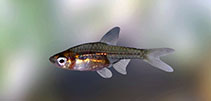
Radios blandos dorsales (total) : 10; Radios blandos anales: 8; Vértebra: 24 - 26. Horadandia atukorali differs from its congener H. brittani by having a more slender body (depth 24.6-29.8 % SL, vs. 27.7-31.9); dorsal profile of head slightly concave (vs. straight) behind level of eye; a greater eye diameter (37-41 % HL, vs. 27-37); origin of dorsal fin slightly posterior to (vs. distinctly behind) origin of pelvic fin; pelvic fin reaching beyond anal-fin origin (vs. just reaching anal-fin origin); origin of dorsal fin located halfway between snout tip and hypural notch (vs. closer to hypural notch); one (vs. none) lateral process on each side of kinethmoid; anterior end of kinethmoid narrow (vs. wide); palatine process of maxilla acute (vs. obtuse); and supraorbital length ~50 % of orbit diameter (vs. ~44 %) (Ref. 94541).
Body shape (shape guide): fusiform / normal.
Inhabits still or slow-moving water, frequenting swamps, rice fields and similar still waters. Found in weedy ponds of coastal plains (Ref. 4832). Common in less saline mangrove swamps and in less polluted canals. Often encountered together with Aplocheilus. Feeds on insects.
Ciclo vital y comportamiento de apareamiento
Madurez | Reproducción | Puesta | Huevos | Fecundidad | Larva
Pethiyagoda, R., 1991. Freshwater fishes of Sri Lanka. The Wildlife Heritage Trust of Sri Lanka, Colombo. 362 p. (Ref. 6028)
Situación en la Lista Roja de la UICN (Ref. 130435: Version 2025-2 (Global))
Amenaza para el ser humano
Harmless
Usos humanos
Pesquerías: sin interés
Herramientas
Informes especiales
Descargar XML
Fuentes de Internet
Estimaciones basadas en modelos
Índice de diversidad filogenética (Referencia
82804): PD
50 = 0.7500 [Uniqueness, from 0.5 = low to 2.0 = high].
Bayesian length-weight: a=0.00891 (0.00382 - 0.02082), b=3.02 (2.82 - 3.22), in cm total length, based on LWR estimates for this (Sub)family-body shape (Ref.
93245).
Nivel trófico (Referencia
69278): 3.2 ±0.40 se; based on food items.
Resiliencia (Referencia
120179): Alto, población duplicada en un tiempo mínimo inferior a 15 meses (Preliminary K or Fecundity.).
Vulnerabilidad pesquera (Ref.
59153): Low vulnerability (10 of 100).
🛈