Taxonomic Remarks
The species Chrysichthys furcatus Günther, 1864 is considered valid in Eschmeyer (CofF ver. Mar. 2012: Ref. 89686). It is treated here a synonym of Chrysichthys nigrodigitatus (Lacepède, 1803) following Risch (1992: Ref. 7324), Risch (2003: Ref. 57126) and Geerinckx et al. (2007: Ref. 81642).
Meio ambiente: milieu / Zona climática / intervalo de profundidade / faixa de distribuição
Ecologia
; Água doce demersal; potamódromo (Ref. 51243); intervalo de profundidade 3 - ? m (Ref. 13851). Tropical; 22°C - 28°C (Ref. 12468); 15°N - 13°S, 16°W - 30°E
Africa: Senegal to Cabinda, Angola (Ref. 3236, 81642). To the north also reported from Mauritania (Ref. 55783), southwards down to the lower Congo River (Ref. 1879) and Angolan coastal rivers (Ref. 120641).
Comprimento de primeira maturação / Tamanho / Peso / Idade
Maturidade: Lm ?, range 14 - ? cm
Max length : 65.0 cm SL macho/indeterminado; (Ref. 81642)
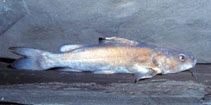
Espinhos dorsais (total) : 2; Raios dorsais (total) : 6; Espinhos anais: 0. Diagnosis: recognized by its pointed snout, the rather small mouth, and the width of the premaxillary tooth plate (1/5-1/3.5, usually 1/4, of head length); vomerine dentition represented by a square to rectangular tooth plate which begins to develop at sizes between 60 and 70 mm standard length; palatine dentition developing at sizes over 100 mm standard length, initially as isolated teeth; second or third branched dorsal-fin ray always the longest; upper caudal-fin lobe much longer than lower lobe; gill rakers long and smooth; other characters, such as length of dorsal fin, number of branched rays in anal fin, and number of gill rakers on first gill arch, are subject to intraspecific variations; sexually mature males and (some) ripe females show considerable morphological differences; such specimens have often been labelled as Chrysichthys furcatus; maturity occurs probably at a rather advanced stage (at over 200 mm SL) and leads to the inflation of head, broadening of mouth and premaxillary tooth plate, shortening of spines and overgrowth of fin-spines by thick skin, the fins becoming more rounded, and the caudal-fin lobes sometimes becoming subequal; the body acquires an emaciated, thinned down appearance (Ref. 57126, 81642). Characters only clear in mature males in
reproduction: adipose fin short, base contained 8-11 times in SL and measuring 28-64% of distance between dorsal fin and adipose fin; maxillary barbel not reaching beyond dorsal spine when extended; head swollen; skin mucous; spines thick and covered with skin (Ref. 81642).
Body shape (shape guide): elongated.
Adults occur in shallow waters of lakes (less than 4 m), over mud and fine sand bottom. Omnivorous, feed on seeds, insects, bivalves and detritus (Ref. 13851). Feeding becomes specialized with age and size, larger fish may feed on decapods and fish (Ref. 27935).
Risch, L. and E.J. Vreven, 2007. Claroteinae. p. 607-629. In M.L.J. Stiassny, G.G. Teugels and C.D. Hopkins (eds.) The fresh and brackish water fishes of Lower Guinea, West-Central Africa. Volume I. Collection Faune et Flore tropicales 42. Institut de Recherche pour le Développement, Paris, France, Muséum National d’Histoire Naturelle, Paris, France, and Musée Royal de l’Afrique Centrale, Tervuren, Belgium. 800 pp. (Ref. 74659)
Status na Lista Vermelha da UICN (Ref. 130435: Version 2025-2 (Global))
Ameaça para os humanos
Harmless
Uso pelos humanos
Pescarias: pouco comercial; Aquacultura: espécies comerciais; peixe esportivo: sim
Ferramentas
Relatórios especiais
Baixar XML
Fontes da internet
Estimativas baseadas em modelos
Índice de diversidade filogenética (Ref.
82804): PD
50 = 0.5000 [Uniqueness, from 0.5 = low to 2.0 = high].
Bayesian length-weight: a=0.01000 (0.00797 - 0.01254), b=2.96 (2.90 - 3.02), in cm total length, based on LWR estimates for this species (Ref.
93245).
Nível Trófico (Ref.
69278): 3.2 ±0.41 se; based on food items.
Resiliência (Ref.
120179): médio(a), tempo mínimo de duplicação da população 1,4 - 4,4 anos (K=0.12-0.65; Fec = 3,086-28,086).
Vulnerabilidade da pesca (Ref.
59153): Low to moderate vulnerability (32 of 100).
🛈
Nutrientes (Ref.
124155): Calcium = 119 [71, 233] mg/100g; Iron = 1.48 [0.88, 2.35] mg/100g; Protein = 16.8 [15.8, 17.9] %; Omega3 = 0.272 [0.115, 0.642] g/100g; Selenium = 87.9 [39.6, 223.6] μg/100g; VitaminA = 18.6 [7.7, 43.8] μg/100g; Zinc = 1.4 [1.0, 2.0] mg/100g (wet weight);