Taxonomic Remarks
Junior synonym Cottus jaxartensis is a valid species according to Sideleva, 2021 (Ref. 129291) and Cottus nudus is a primary homonyn and permanently invalid (include in Ref. 129291 Quote).
Περιβάλλον: περιβάλλον / κλιματική ζώνη / εύρος βάθους / εύρος διανομής
Οικολογία
; Γλυκού νερού; Υφάλμυρο βενθικό(ς); pH range: 7.0 - 7.5; dH range: 10 - ?; ποταμόδρομος (Ref. 51243); εύρος βάθους 2 - 2 m (Ref. 58018). Subtropical; 1°C - 16°C (Ref. 45166); 70°N - 40°N, 6°W - 60°E
Europe: North Baltic in Scandinavia south to stream Maurine in southwesternmost of corner of Baltic basin (Germany); lower reaches of streams and rivers and along coast of Sweden, Finland, Russia southwest to Estonia; Danube (except upper tributaries Save and Arges), Elbe, Ems, Weser and Rhône drainages; tributaries of upper Rhine downriver (northward) to about Mannheim; a few of uppermost tributaries of River Tevere, central Italy; Adriatic drainages from Potenza in Italy to Zrmanja in Croatia, except Timavo spring. Locally introduced in Scheldt drainage in Belgium.
Μήκος κατά την πρώτη ωρίμανση / Μέγεθος / Βάρος / Ηλικία
Γεννητική Ωρίμανση: Lm 4.2 range ? - ? cm
Max length : 18.0 cm TL αρσενικό/απροσδιόριστο; (Ref. 556); common length : 10.0 cm TL αρσενικό/απροσδιόριστο; (Ref. 556); μεγ. αναφερόμενη ηλικία: 10 έτη (Ref. 74370)
Ραχιαίες άκανθες (συνολικά) : 6 - 8; Μαλακές ραχιαίες ακτίνες (συνολικά) : 15 - 18; Εδρικές άκανθες: 0; Μαλακές εδρικές ακτίνες: 10 - 13; Σπόνδυλοι: 31 - 34. Caudal fin with 13 to 14 rays (Ref. 40476).
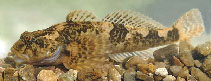
Body shape (shape guide): fusiform / normal.
Occurs in cold, clear and fast-flowing water of small stream to medium-sized rivers as well as on gravel or rocky shores of cold lakes and in slightly brackish waters along eastern coast of Baltic coast (Ref. 59043). Feeds on small bottom invertebrates, mainly insects, crustaceans. Pink to yellow eggs are found in clumps attached to undersides of large stones (Ref. 41678). Contrary to statements in older literature, eggs and larvae of fishes are not a common food item (Ref. 45167).
Spawns once a year for several years in low productivity streams, but exhibits multiple spawning within a season in high productivity environments (Ref. 40290, 40754). Male protects several batches of eggs--deposited below a stone--for about 3 weeks. Larvae are not guarded and may occasionally been eaten (Ref. 45166). Also Ref. 26506.
Freyhof, J., M. Kottelat and A. Nolte, 2005. Taxonomic diversity of European Cottus with description of eight new species (Teleostei: Cottidae). Ichthyol. Explor. Freshwat. 16(2):107-172. (Ref. 55856)
Κατάσταση Κόκκινου Καταλόγου IUCN (Ref. 130435: Version 2025-2 (Global))
Απειλή για τον άνθρωπο
Harmless
Ανθρώπινες χρήσεις
αλιεία: χωρίς ενδιαφέρον; δόλωμα: occasionally
Εργαλεία
Ειδικές εκθέσεις
Λήψη XML
Διαδικτυακές πηγές
Εκτιμήσεις βάσει μοντέλων
Δείκτης φυλογενετικής ποικιλότητας (Αναφ.
82804): PD
50 = 0.5000 [Uniqueness, from 0.5 = low to 2.0 = high].
Bayesian length-weight: a=0.00871 (0.00586 - 0.01294), b=3.13 (3.01 - 3.25), in cm total length, based on LWR estimates for this species & (Sub)family-body (Ref.
93245).
Τροφικό Επίπεδο (Αναφ.
69278): 3.2 ±0.2 se; based on diet studies.
Ελαστικότητα (Αναφ.
120179): Μεσαίο(α), ελάχιστος χρόνος για διπλασιασμό πληθυσμού 1,4 - 4,4 έτη (tm=1-3).
Ευπάθεια στην αλιεία (Ref.
59153): Low vulnerability (10 of 100).
🛈