>
Siluriformes (Catfishes) >
Auchenoglanididae (Flatnose catfishes)
Etymology: Auchenoglanis: Greek, auchen = neck + Greek, glanis = a fish that can eat the bait without touching the hook; a cat fish (Ref. 45335).
More on author: Valenciennes.
Taxonomic Remarks
The species Auchenoglanis acuticeps Pappenheim, 1914 and Auchenoglanis occidentalis tchadensis Pellegrin, 1909 are considered valid in Eschmeyer (CofF ver. Jul. 2011: Ref. 87661). We postpone this change until a more complete assessment is published.
Ambiente: milieu / zona climatica / distribuzione batimetrica / gamma di distribuzione
Ecologia
; acqua dolce demersale; pH range: 6.5 - 7.8; dH range: ? - 28; potamodromo (Ref. 51243). Tropical; 21°C - 25°C (Ref. 2060)
Africa: most rivers of West Africa (Ref. 57126, 78218), Chad basin (Ref. 3236, 57126), Congo River drainage (Ref. 3236, 78218), Lake Tanganyika (Ref. 78218), Nile system in Ethiopia and Sudan (Ref. 28714, 58460), Lake Turkana drainage, including Omo River (Ref. 3236, 52331, 58460), and Shabeelle (Ref. 3236, 58460).
Lunghezza alla prima maturità / Dimensione / Peso / Età
Maturità: Lm ?, range 39 - ? cm
Max length : 70.0 cm SL maschio/sesso non determinato; (Ref. 4967)
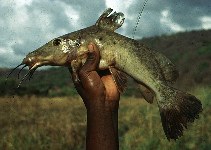
Spine dorsali (totale) : 2; Raggi dorsali molli (totale) : 7 - 8; Spine anali: 3 - 4; Raggi anali molli: 6 - 8. Diagnosis: head width usually less than 2/3 of standard length (Ref. 57126). Snout long and pointed, generally greater than half the head length in adults (Ref. 28714), length more than 0.9 times the head width in adults (less in juveniles) (Ref. 57126). Hind margin of adipose fin rounded; premaxillary dentition forming (in adults) two close-set oval plates (Ref. 57126). Maxillary barbel often blackish and only rarely reaching to anterior margin of opercula (Ref. 57126), usually not reaching beyond eye and much shorter than outer mandibular barbel (Ref. 28714, 81642). 8-12 (usually 10 or 11) gill rakers on lower limb of first gill arch; palatine membrane with multiple invaginations, 1-4 of them forming longer lobes; dorsal margin of cleithral process ending in a point (visible only in adults)(Ref. 57126).
Body shape (shape guide): fusiform / normal; Cross section: circular.
Inhabits lakes and large rivers (Ref. 4967). Has never been observed in large quantities in forested areas (Ref. 57126). Occurs in shallow water with muddy bottom. Bottom feeder, omnivore, feeds on plankton, seeds, detritus (Ref. 13868), mollusks (Ref. 13868, 28714), mud, debris (Ref. 28714), insect larvae (Ref. 6868, 28714), worms and small Crustacea (Ref. 6868). Oviparous (Ref. 205). Nested eggs are guarded by the male parent (Ref. 47642). Furthermore, the male plays host to eggs and young of Dinotopterus cunningtoni which takes advantage of the already prepared nest and feed on the host brood (Ref. 49546). An example of interspecific brood care.
Ciclo vitale e comportamento di accoppiamento
Maturità | Riproduzione | Deposizione | Uova | Fecondità | Larve
Eggs are brooded and guarded by the male parent (Ref. 47642).
Risch, L.M., 2003. Claroteidae. p. 60-96 In C. Lévêque, D. Paugy and G.G. Teugels (eds.) Faune des poissons d'eaux douce et saumâtres de l'Afrique de l'Ouest, Tome 2. Coll. Faune et Flore tropicales 40. Musée Royal de l'Afrique Centrale, Tervuren, Belgique, Museum National d'Histoire Naturalle, Paris, France and Institut de Recherche pour le Développement, Paris, France. 815 p. (Ref. 57126)
Stato della Lista Rossa IUCN (Ref. 130435: Version 2025-2 (Global))
Minaccia per l'uomo
Harmless
Usi umani
Pesca: commerciale
Strumenti
Rapporti speciali
Scarica XML
Fonti Internet
Stime basate su modelli
Indice di diversità filogenetica (Fonte Biblio.
82804): PD
50 = 0.7500 [Uniqueness, from 0.5 = low to 2.0 = high].
Bayesian length-weight: a=0.01023 (0.00559 - 0.01873), b=3.02 (2.85 - 3.19), in cm total length, based on LWR estimates for this species & (Sub)family-body (Ref.
93245).
Livello trofico (Fonte Biblio.
69278): 2.9 ±0.33 se; based on food items.
Generation time: 3.7 ( na - na) years. Estimated as median ln(3)/K based on 1
growth studies.
Resilienza (Fonte Biblio.
120179): Medio, tempo minimo di raddoppiamento della popolazione 1.4 - 4.4 anni (K=0.3).
Vulnerabilità della pesca (Ref.
59153): Moderate vulnerability (38 of 100).
🛈
Nutrienti (Ref.
124155): Calcium = 95.6 [51.8, 186.1] mg/100g; Iron = 1.43 [0.86, 2.46] mg/100g; Protein = 17.2 [16.0, 18.2] %; Omega3 = 0.402 [0.159, 1.013] g/100g; Selenium = 77.5 [35.5, 168.4] μg/100g; VitaminA = 22 [8, 53] μg/100g; Zinc = 1.46 [0.98, 2.09] mg/100g (wet weight);