>
Tetraodontiformes (Puffers and filefishes) >
Triacanthodidae (Spikefishes) > Triacanthodinae
Etymology: Paratriacanthodes: Greek, para in the side of + Greek, tres, tria = three + Greek, akantha = thorn (Ref. 45335).
More on author: Fowler.
Entorno: milieu / zona climática / rango de profundidad / gama de distribución
Ecología
marino batidemersal; rango de profundidad 418 - 920 m (Ref. 33352). Deep-water
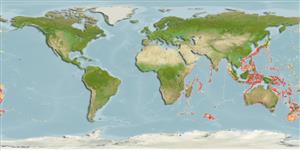
Indo-Pacific: East Africa, Japan, Kyushu-Palau Ridge, South China Sea, Australia, and south to New Caledonia and the Norfolk Ridge.
Tamaño / Peso / Edad
Madurez: Lm ? range ? - ? cm
Max length : 12.0 cm SL macho / no sexado; (Ref. 559)
Descripción breve
Claves de identificación | Morfología | Morfometría
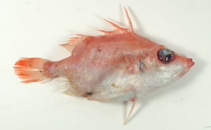
Espinas dorsales (total) : 6; Radios blandos dorsales (total) : 15; Espinas anales: 0; Radios blandos anales: 13. Reddish pink in color, with 3 pale lines, silvery blue from lower jaw to anus (Ref. 6660).
Body shape (shape guide): short and / or deep.
Ciclo vital y comportamiento de apareamiento
Madurez | Reproducción | Puesta | Huevos | Fecundidad | Larva
Tyler, J.C., 1986. Triacanthodidae. p. 887-890. In M.M. Smith and P.C. Heemstra (eds.) Smiths' sea fishes. Springer-Verlag, Berlin. (Ref. 6660)
Situación en la Lista Roja de la UICN (Ref. 130435: Version 2025-2 (Global))
Amenaza para el ser humano
Harmless
Usos humanos
Herramientas
Informes especiales
Descargar XML
Fuentes de Internet
Estimaciones basadas en modelos
Temperatura preferida (Referencia
123201): 2.3 - 10.4, mean 7.9 °C (based on 364 cells).
Índice de diversidad filogenética (Referencia
82804): PD
50 = 0.6250 [Uniqueness, from 0.5 = low to 2.0 = high].
Bayesian length-weight: a=0.01995 (0.00906 - 0.04395), b=3.01 (2.83 - 3.19), in cm total length, based on all LWR estimates for this body shape (Ref.
93245).
Nivel trófico (Referencia
69278): 4.3 ±0.8 se; based on size and trophs of closest relatives
Vulnerabilidad pesquera (Ref.
59153): Low vulnerability (10 of 100).
🛈