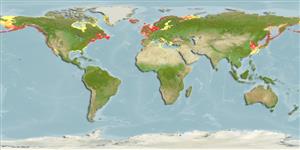
Lingkungan: lingkungan / zona iklim / kisaran kedalaman / jangkauan distribusi
Ekologi
laut; air tawar; payau bentopelagis; anadromus (ruaya dari laut ke air tawar) (Ref. 138280); kisaran kedalaman 0 - 100 m (Ref. 50550). Subtropical; 4°C - 20°C (Ref. 1672); 72°N - 25°N, 117°E - 60°E (Ref. 26213)
Circumarctic and temperate regions: Extending south to the Black Sea, southern Italy, Iberian Peninsula, North Africa; in Eastern Asia north of Japan (35°N), in North America north of 30-32°N; Greenland.
Panjang pada saat jatuh tempo pertama / Ukuran / Berat / umur
Kematangan: Lm 5.5 range ? - ? cm
Max length : 11.0 cm TL jantan/; (Ref. 35388); common length : 5.1 cm TL jantan/; (Ref. 1998); Umur maksimum dilaporkan: 8 Tahun (Ref. 72489)
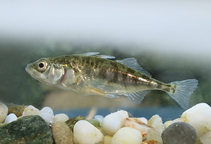
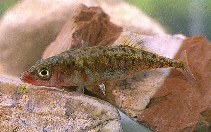
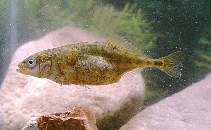
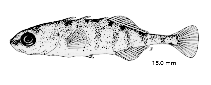
Duri punggung (Keseluruhan (total)) : 2 - 4; duri punggung lunak (Keseluruhan (total)) : 10 - 14; Duri dubur: 1; Sirip dubur lunak: 7 - 11; vertebrata, bertulang belakang: 29 - 34. Distinguished uniquely from its congeners in Europe by having trunk and caudal peduncle covered by a complete series of 29-35 bony scutes. Other characters important to separate this species from other species of the genus include posterior edge of scutes crenulated and scutes forming a lateral keel on caudal peduncle. Scutes may be missing on posterior part of trunk in hybrid zone with Gasterosteus gymnurus and in some isolated freshwater populations of northeastern Europe (Ref. 59043). Identified by the 3 to 4 sharp, free spines before the dorsal fin, the pelvic fin reduced to a sharp spine and a small ray, and the series of plates along the sides of the body (Ref. 27547). Gill rakers long and slender, 17 to 25 on the first arch or strictly freshwater forms, 1 or 2 more in anadromous forms; lateral line with microscopic pores (Ref. 27547). The anadromous form is fully plated, with up to 37 plates on the sides and a rather pronounced keel on each side of the caudal peduncle (Ref. 27547). Dorsal spines separated from each other and from the soft-rayed fins, each spine having a reduced membrane attached to its posterior side; anal spine free from rest of the fin; posterior margin of pectorals nearly truncate; caudal truncate to slightly indented (Ref. 27547). Freshwater forms usually mottled brown or greenish; anadromous forms silvery green to bluish black (Ref. 27547). A few isolated populations are black (Ref. 27547). Sides usually pale; belly yellow, white or silvery (Ref. 27547). Fins pale; pectoral rays often have dark dots (Ref. 27547). Breeding males (except for black forms) become brilliant bluish or green with blue or green eyes, and the forward part of the body, especially the breast region, turns bright red or orange (Ref. 27547). Caudal fin with 12 rays (Ref. 2196).
Body shape (shape guide): fusiform / normal.
Adults occur in fresh waters, estuaries and coastal seas (Ref. 4119). Anadromous, with numerous non-anadromous populations in brackish or pure freshwater, rarely in marine waters. In the sea, confined to coastal waters. In freshwater, adults prefer to live in small stream but may occur in a variety of habitats including lakes and large rivers (Ref. 59043). Inhabit shallow vegetated areas, usually over mud or sand (Ref. 5723). Form schools. Young associated with drifting seaweed (Ref. 12114, 12115). Juveniles move to the sea (anadromous populations) or to deeper, larger water bodies (freshwater populations) in July-August, forming large feeding schools (Ref. 59043). Feed on worms, crustaceans, larvae and adult aquatic insects, drowned aerial insects, and small fishes; has also been reported to feed on their own fry and eggs (Ref. 1998). Eggs are found in nests constructed from plant material (Ref. 41678). Males build, guard and aerate the nest where the eggs are deposited (Ref. 205). Maximum length in freshwater is 8 cm while in saltwater is 11 cm (Ref. 35388). Occasionally taken commercially in Scandinavia and processed into fishmeal and oil (Ref. 28219, 28964). Commonly used as a laboratory animal (Ref. 1998). A large bibliography is available at www.geocities.com/CapeCanaveral/Hall/1345/stickbibl.html.
Spawning behavior is similar for both freshwater and anadromous forms (Ref. 28966). Just before breeding, males become very territorial. The male builds a nest of plant-material glued together with spiggin, a protein produced in the kidney (Ref. 52349). Once a nest is built, the male entices the female into the nest by performing a courtship dance which is a series of zigzag movements (Ref. 1998). A receptive female follows the male who points the opening of the nest by posing above it with his head down. The female enters the nest, deposits up to a few hundred eggs, and is driven out by the male after eggs have been deposited. The male then enters the nest to fertilize the eggs. The male can choose to court another female to enter the nest and lay eggs before entering himself to fertilise the deposited eggs. Females may lay eggs in several nests over a period of several days or may be courted by the same male (Ref. 27547). The male guards and ventilates the eggs and young (Ref. 1998). During spawning season, males develop a bright orange to red belly and blue-green flank and eyes. Eggs hatch in 7-8 days. Anadromous forms usually die of exhaustion after spawning cycle. Freshwater individuals are able to complete several cycles within one year or sometimes over several years (Ref. 59043).
Page, L.M. and B.M. Burr, 2011. A field guide to freshwater fishes of North America north of Mexico. Boston : Houghton Mifflin Harcourt, 663p. (Ref. 86798)
Status IUCN Red List (Ref. 130435: Version 2025-2 (Global))
ancaman kepada manusia
Harmless
penggunaan manusia
Perikanan: nilai komersial kecil; Akuarium: Akuarium publik
Alat, peralatan
laporan khas
muat turun XML
Sumber internet
Estimasi berdasarkan model
Suhu yang disukai (Acuan
123201): 2 - 13.5, mean 8 °C (based on 2296 cells).
Indeks keanekaragaman filogenetik (Acuan
82804): PD
50 = 0.5156 [Uniqueness, from 0.5 = low to 2.0 = high].
Bayesian length-weight: a=0.00977 (0.00665 - 0.01435), b=3.09 (2.99 - 3.19), in cm total length, based on LWR estimates for this species (Ref.
93245).
Tingkat Trofik (Acuan
69278): 3.3 ±0.2 se; based on diet studies.
Daya lenting (Acuan
120179): Tinggi, Waktu penggandaan populasi minimum kurang dari 15 bulan (K=0.6-1.8; tm=1; tmax=4; Fec=80).
Kerentanan Penangkapan Ikan (Ref.
59153): Low vulnerability (10 of 100).
🛈
Kerentanan Iklim (Ref.
125649): Low to moderate vulnerability (26 of 100).
🛈
Nutrisi (Ref.
124155): Calcium = 220 [83, 486] mg/100g; Iron = 2 [1, 4] mg/100g; Protein = 17.7 [16.5, 18.9] %; Omega3 = 0.541 [0.259, 1.159] g/100g; Selenium = 33.9 [15.0, 73.3] μg/100g; VitaminA = 22.6 [8.0, 65.8] μg/100g; Zinc = 1.7 [1.1, 2.4] mg/100g (wet weight);