>
Salmoniformes (Salmons) >
Salmonidae (Salmonids) > Salmoninae
Etymology: Oncorhynchus: Greek, onyx, -ychos = nail + Greek, rhyngchos = snout (Ref. 45335).
More on author: Walbaum.
Lingkungan: lingkungan / zona iklim / kisaran kedalaman / jangkauan distribusi
Ekologi
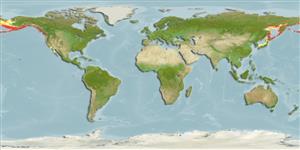
laut; air tawar; payau bentopelagis; anadromus (ruaya dari laut ke air tawar) (Ref. 132363); kisaran kedalaman 0 - 250 m (Ref. 50550), usually ? - 61 m (Ref. 96339). Temperate; 0°C - 24°C (Ref. 35682); 67°N - 24°N, 130°E - 110°W (Ref. 117423)
North Pacific: Korea , Japan, Okhotsk and Bering Sea (Ref. 1998), Arctic Alaska south to San Diego, California, USA. Asia: Iran (Ref. 39702).
Panjang pada saat jatuh tempo pertama / Ukuran / Berat / umur
Kematangan: Lm 70.0 range ? - ? cm
Max length : 100.0 cm FL jantan/; (Ref. 559); common length : 58.0 cm TL jantan/; (Ref. 3561); Berat maksimum terpublikasi: 18.1 kg (Ref. 56631); Umur maksimum dilaporkan: 7 Tahun (Ref. 1998)
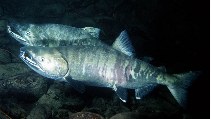
Duri punggung (Keseluruhan (total)) : 0; duri punggung lunak (Keseluruhan (total)) : 10 - 14; Duri dubur: 0; Sirip dubur lunak: 13 - 17; vertebrata, bertulang belakang: 59 - 71. Distinguished by the lack of distinct black spots on the back and tail and by the presence of 18 to 28 short, stout, smooth gill rakers on the first arch (Ref. 27547). Pelvic fins with axillary process; caudal truncate to slightly emarginate (Ref. 27547). Large individuals are steel-blue dorsally, with speckles of black; silver on the sides; silvery to white ventrally. Males have tinges of black on the tips of its caudal, anal and pectoral fins. Spawning males are dark olive to black dorsally; grey-red with green vertical bars on the sides; dark grey ventrally; anal and pelvic fins with white tips. Spawning females resemble spawning males but less distinctly marked.
Body shape (shape guide): fusiform / normal; Cross section: compressed.
Inhabits ocean and coastal streams (Ref. 86798). Migrating fry form schools in estuaries, remain close to shore for a few months and finally disperse to enter the sea (Ref. 1998). Epipelagic (Ref. 58426). Juveniles and adults feed mainly on copepods, tunicates and euphausiids but also on pteropods, squid and small fishes (Ref. 1998). Adults cease feeding in freshwater (Ref. 1998). Males and females die after spawning. The catch is mostly canned but also sold fresh, dried-salted, smoked, and frozen. Eaten steamed, fried, broiled, boiled, microwaved, and baked (Ref. 9988). Utilized for caviar.
Enters freshwater during advanced stage of sexual development and spawning occurs almost immediately (Ref. 1998). Spawning occurs at depths of ~3 meters, current speeds of ~20cm/sec. near the head waters over sand and pebbles at 4-11° C water temperature. At spawning time the female excavates a hole of around 1 meter diameter and 50 cm depth before spawning can occur (Ref. 12218). Nest building is done by the female by lying on one side and lashing its tail to displace the sand and silt on the river bed. The pair then settles in the nest, mouths gape, and with rapid vibration of the pair, eggs and milt are released. The female then covers the nest. Males are aggressive and may spawn with different females; females likewise may spawn with other males and therefore builds different nests. Adults die after a week (Ref. 1998). A fish spawns 700-7,000 eggs in two to three egg releases. Eggs are ~300-3,500 per spawn. Egg size is ~6.7 mm, water temp. is 8-10°C at 60 days before hatching. Larva size is around 16 mm. Come springtime the juveniles go to the ocean and come back 3-4 years later to their exact birthplace. This fish reaches maturity in 2-4 years. Larvae are found around the spawning site, Juveniles are found around the coast. Juveniles migrate to the ocean at ~27-45 mm during February at water temperatures around 4° C (Ref. 12218).
Reproductive strategy: synchronous ovarian organization, determinate fecundity (Ref. 51846).
Page, L.M. and B.M. Burr, 2011. A field guide to freshwater fishes of North America north of Mexico. Boston : Houghton Mifflin Harcourt, 663p. (Ref. 86798)
Status IUCN Red List (Ref. 130435: Version 2025-2 (Global))
ancaman kepada manusia
Harmless
penggunaan manusia
Perikanan: bernilai komersial tinggi; Budidaya air: komersial; Ikan buruan: ya; Akuarium: Akuarium publik
Alat, peralatan
laporan khas
muat turun XML
Sumber internet
Estimasi berdasarkan model
Suhu yang disukai (Acuan
123201): 1.1 - 8.3, mean 3.3 °C (based on 192 cells).
Indeks keanekaragaman filogenetik (Acuan
82804): PD
50 = 0.5000 [Uniqueness, from 0.5 = low to 2.0 = high].
Bayesian length-weight: a=0.01413 (0.00741 - 0.02693), b=3.10 (2.94 - 3.26), in cm total length, based on LWR estimates for this species & Genus-body shape (Ref.
93245).
Tingkat Trofik (Acuan
69278): 3.7 ±0.2 se; based on diet studies.
Daya lenting (Acuan
120179): sedang, Waktu penggandaan populasi minimum 1.4 - 4.4 tahun (K=0.27-0.45; tm=2-5; tmax=6).
Prior r = 0.32, 95% CL = 0.21 - 0.48, Based on 8 full stock assessments.
Kerentanan Penangkapan Ikan (Ref.
59153): Moderate to high vulnerability (49 of 100).
🛈
Kerentanan Iklim (Ref.
125649): High to very high vulnerability (71 of 100).
🛈
Nutrisi (Ref.
124155): Calcium = 15.6 [4.4, 41.3] mg/100g; Iron = 0.337 [0.168, 0.758] mg/100g; Protein = 18.4 [17.2, 19.5] %; Omega3 = 1.71 [0.78, 3.77] g/100g; Selenium = 110 [32, 369] μg/100g; VitaminA = 13.3 [4.6, 41.2] μg/100g; Zinc = 0.424 [0.266, 0.821] mg/100g (wet weight);