Klassifizierung / Names
Namen | Synonyme | Catalog of Fishes(Gattung, Arten) | ITIS | CoL | WoRMS | Cloffa
Elasmobranchii (Haie und Rochen) (sharks and rays) >
Rajiformes (Skates and rays) >
Rajidae (Skates)
Eponymy: Gilbert Percy Whitley (1903–1975) was a British-born Australian ichthyologist and malacologist. [...] (Ref. 128868), visit book page.
Umwelt: Milieu / Klimazone / Tiefenbereich / Verbreitungsgebiet
Ökologie
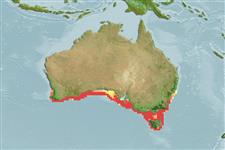
seewasser demersal; tiefenbereich 1 - 170 m (Ref. 6871). Temperate; 32°S - 44°S, 115°E - 153°E (Ref. 114953)
Eastern Indian Ocean: endemic to southern Australia.
Größe / Gewicht / Alter
Geschlechtsreife: Lm ? range ? - ? cm
Max length : 200 cm TL Männchen/unbestimmt; (Ref. 114953)
Kurzbeschreibung
Bestimmungsschlüssel | Morphologie | Morphometrie
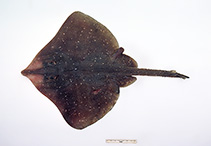
Dorsal surface greyish or greyish brown with irregularly spaced white flecks, ventral surface cream or white, occasionally with greyish areas. Disc quadrangular, broader than long. Snout of moderate length, broadly rounded and knob-like at snout tip. Tail short, very depressed, broad; lateral skin folds prominent. A row of 1-5 thorns on nuchal and shoulder region, orbital and malar thorns absent. Alar thorns retractable. Tail with 1-3 rows of thorns, outer rows located near lateral margin.
Body shape (shape guide): other.
Most abundant in shallow water near shore (Ref. 6871). Found over soft bottom (Ref. 7300, 75154). Recorded to be found at 345 m depth (Ref. 114953). Diet mainly consists of crabs, octopuses and small bony fishes (Ref. 114953). Oviparous (Ref. 50449). Males reaches maturity at ca. 127 cm TL (Ref. 114953). Eggs have horn-like projections on the shell (Ref. 205). Egg cases ca. 22 cm long, hatch size at ca. 20 cm TL (Ref. 114953). Thorny tail can inflict a minor injury (Ref. 6871).
Lebenszyklus und Paarungsverhalten
Geschlechtsreife | Fortpflanzung | Ablaichen | Eier | Fruchtbarkeit | Larven
Oviparous, paired eggs are laid. Embryos feed solely on yolk (Ref. 50449).
Last, P.R. and J.D. Stevens, 1994. Sharks and rays of Australia. CSIRO, Australia. 513 p. (Ref. 6871)
IUCN Rote Liste Status (Ref. 130435: Version 2025-2 (Global))
Bedrohung für Menschen
Traumatogenic (Ref. 6871)
Nutzung durch Menschen
Tools
Zusatzinformationen
Download XML
Internet Quellen
Schätzungen auf der Grundlage von Modellen
Bevorzugte Temperatur (Ref.
123201): 14 - 18.2, mean 16.3 °C (based on 139 cells).
Phylogenetischer Diversitätsindex (Ref.
82804): PD
50 = 1.0000 [Uniqueness, from 0.5 = low to 2.0 = high].
Bayesian length-weight: a=0.00302 (0.00141 - 0.00645), b=3.24 (3.07 - 3.41), in cm total length, based on LWR estimates for this (Sub)family-body shape (Ref.
93245).
Trophische Ebene (Ref.
69278): 4.0 ±0.6 se; based on size and trophs of closest relatives
Widerstandsfähigkeit (Ref.
120179): niedrig, Verdopplung der Population dauert 4,5 - 14 Jahre. (Fec assumed to be <100).
Anfälligkeit der Fischerei (Ref.
59153): Very high vulnerability (90 of 100).
🛈
Nährstoffe (Ref.
124155): Calcium = 6.63 [1.27, 32.23] mg/100g; Iron = 0.262 [0.068, 0.736] mg/100g; Protein = 17.3 [14.6, 20.0] %; Omega3 = 0.728 [0.235, 2.708] g/100g; Selenium = 13.4 [3.9, 43.6] μg/100g; VitaminA = 10.1 [3.3, 32.6] μg/100g; Zinc = 0.335 [0.162, 0.594] mg/100g (wet weight);