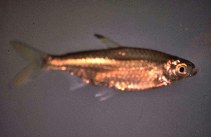
Taxonomic Remarks
Affinities: most similar to M. elongatus, from which it differs in the presence of multicuspid (vs conical, monocuspid) inner dentary teeth, inner premaxillary and outer dentary teeth with greater number of cusps and a slightly more robus body (Ref. 80290).
Окружающая среда: среда / климатическая зона / пределы глубины / диапазон распространения
экология
; пресноводный пелагический; pH range: 6.2 - 8.0; dH range: ? - 25; мигрирует в реке (Ref. 51243). Tropical; 22°C - 26°C (Ref. 1672)
Africa: Congo, Okavango, Zambezi (Ref. 7248, 120641), Kunene and east coast rivers south to the Pongolo (Ref. 7248), Cross and Sanaga Rivers (Ref. 80290) and Tanzania (Ref. 4967). Nilo-Sudan and West-African reports of M. acutidens (e.g. Ref. 367, 51193) are misidentifications of M. elongatus (see DVD version of Ref. 81279; see also Ref. 2880).
Длина при первой зрелости / Размер / Вес / Возраст
половая зрелость: Lm 3.4 range ? - ? cm
Max length : 9.0 cm SL самец/пол неопределен; (Ref. 4967); наибольший вес (опубликованные данные): 2.00 g (Ref. 3799); наибольший возраст (опубликованны данные): 3.00 годы (Ref. 7248)
колючие лучи спинного плавника (общее число) : 0; членистые (мягкие) лучи спинного плавника (общее число) : 10 - 11; колючие лучи анального плавника: 0; членистые (мягкие) лучи анального плавника: 17 - 20. Diagnosis: inner dentary teeth multicuspid; 14-17 anal fin branched rays; dorsal fin apical tip black; scales of flank without melanophores concentrated along basal margin, pigment diffuse or absent (Ref. 80290).
Body shape (shape guide): fusiform / normal; Cross section: oval.
Shoals in clear, flowing or standing, open water; appears to co-exist with the tigerfish Hydrocynus forskalii in open water although it is heavily preyed upon by that predator, particularly those shoals of tigerfish ranging up to 45 cm in length (Ref. 13337). Omnivorous, often feeding from surface waters on winged insects; also takes insect larvae, crustaceans and eggs and fry of other fish (Ref. 13337). Matures after a year; partial spawner of moderate fecundity, with usually fewer than 700 eggs per female; shoals migrate upstream after first summer rains; breeds throughout the summer months; used as forage fish and as bait for tigerfish and pike (Ref. 7248).
Жизненный цикл и брачное поведение
половая зрелость | размножение | нерест | икра | Плодовитость | личинки
Skelton, P.H., 1993. A complete guide to the freshwater fishes of southern Africa. Southern Book Publishers. 388 p. (Ref. 7248)
Статус Красного Списка МСОП (Ref. 130435: Version 2025-2 (Global))
Угроза для людей
Harmless
Использование человеком
рыболовство: интереса не представляет; аквариум: коммерческий; наживка: usually
дополнительная информация
инструменты
Специальные отчеты
Скачать в формате XML
ресурсы в Интернет
Оценки, основанные на моделях
Индекс филогенетического разнообразия (ссылка
82804): PD
50 = 0.5000 [Uniqueness, from 0.5 = low to 2.0 = high].
Bayesian length-weight: a=0.01148 (0.00633 - 0.02083), b=3.11 (2.95 - 3.27), in cm total length, based on LWR estimates for this species & (Sub)family-body (Ref.
93245).
Трофический уровень (ссылка
69278): 2.9 ±0.33 se; based on food items.
Generation time: 1.8 ( na - na) years. Estimated as median ln(3)/K based on 2
growth studies.
устойчивость к внешним воздействиям (ссылка
120179): высокий, минимальное время удвоения популяции до 15 месяцев (K=0.63; tmax=3).
Уязвимость рыбной ловли (Ref.
59153): Low vulnerability (23 of 100).
🛈