分類 / 名稱
俗名 | 同種異名 | Catalog of Fishes(屬, 種) | ITIS | CoL | WoRMS | Cloffa
Teleostei >
Cichliformes (Cichlids, convict blennies)
鱸形目 (Cichlids, convict blennies) >
Cichlidae (Cichlids)
慈鯛科魚類 (Cichlids) > Pseudocrenilabrinae
Etymology: Hemichromis: Greek, hemis = half + Greek, chromis = a fish, perhaps a perch (Ref. 45335).
More on author: Peters.
環境: 環境 / 氣候帶 / 深度上下限 / 配送範圍
生態學
; 淡水 底中水層性; pH range: 7.0 - ? ; dH range: ? - 15; 河川洄游 (Ref. 51243). 熱帶; 23°C - 25°C (Ref. 2060); 27°N - 29°S, 17°W - 47°E
Africa: widely distributed in West Africa, where it is known from most hydrographic basins, from the Senegal to the Chad basins, including the West African coastal rivers and the middle and lower parts of the Chad basin (Ref. 53405, 123791). Also in the Nile basin (Ref. 5644, 28714) and in the upper Zambezi (Ref. 5644). Distribution of this species and overlap with Hemichromis elongatus unclear, but probably absent from the Congo basin (see also Ref. 43352, 52307, 53405, 81260). Introduced around 1970 in a stream fed by hot springs in Villach (Austria) (Ref. 59043).
非洲: 塞內加爾到尼羅河流域與從查德湖到 Ituri 河在剛果河流域與尚比西河上游。 也已知來自象牙海岸與迦納。 (參考文獻 272) 其他地方,廣泛分佈於非洲西方部。
初熟時的長度 / 大小 / 重量 / 年齡
成熟度: Lm 8.0 range ? - ? cm
Max length : 21.0 cm SL 雄魚/尚未辨別雌雄; (Ref. 123661); 最大體重: 300.00 g (Ref. 3799)
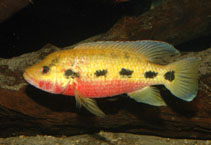
背棘 (總數) : 13 - 15; 背的軟條 (總數) : 11 - 14; 臀棘: 3; 臀鰭軟條: 8 - 11. Diagnosis: With 5 dark blotches or cross bars on sides, often alternating with narrower intercalary bars, the first blotch confluent with the opercular spot, the fifth on caudal-fin base; upper profile of snout straight or concave (Ref. 53405). Hemichromis fasciatus can be distinguished from H. elongatus by the small black dots between the first three dark stripes on the flanks of the body of adults in most populations; it can further be distinguished from H. elongatus by a combination of overlapping morphometrics, mainly by: a high number of anal fin soft rays, 8-11 vs. 7-10; number of longitudinal line scales, 29-32 vs. 28-30; number of lower lateral line scales, 10-14 vs. 8-12; a short snout, 27.2-35.2% of head length vs. 27.4-36.4%; short premaxillary pedicel length, 38-49.7% of head length vs. 38.0-51.2%; short head length, 33.1-38.7% of standard length vs. 34.2-40.3%; short predorsal distance, 32.7-39.6% of standard length vs. 34.3-41.3%; short prepectoral distance, 32.9-40.3% of standard length vs. 35.1-42.3%; short prepelvic distance, 35.4-45.3% of standard length vs. 38.2-48.1%; Hemichromis fasciatus is distributed in West Africa while H. elongatus occurs in the southern part of Lower Guinea and the Congo basin in Cameroon (Ref. 123791).
Body shape (shape guide): fusiform / normal.
Found in both forest and savannah biotopes (Ref. 5644); present in littoral riverine habitats and permanent floodplain lagoons with clear water. It feeds on shrimps, small fishes (Ref. 52307) and insects. The species controls large swaths of territory, even larger than those controlled by Hemichromis elongatus; breeding is similar to Hemichromis elongatus (Ref. 52307). A nesting substrate spawner which breeds in the early summer. Pair-bonding well defined (Ref. 52307). Used for tilapia control (Ref. 4537). Maximum TL was recorded at 26.5 cm.
最大體長TL記錄為 26.5 公分。 出現於森林和稀樹大草原生存環境;(參考文獻 5644) 出現在海濱的河中棲地與永久的洪泛區潟湖,水質清澈的地方。 吃蝦,昆蟲與小魚。 在初夏繁殖的一隻築巢底部產卵魚。 用來了吳郭魚控制。 (參考文獻 4537)
生命週期和交配行為
成熟度 | 繁殖 | 產卵場 | 卵 | 孕卵數 | 仔魚
Introduced individuals in Austria reported to form pairs during spawning. Female deposits eggs on exposed hard surfaces such as stones or wood. Both parents guard larvae and juveniles for 4-8 weeks (Ref. 59043).非洲: 塞內加爾到尼羅河流域與從查德湖到 Ituri 河在剛果河流域與尚比西河上游。 也已知來自象牙海岸與迦納。 (參考文獻 272) 其他地方,廣泛分佈於非洲西方部。
Teugels, G.G. and D.F.E. Thys van den Audenaerde, 1992. Cichlidae. p. 714-779. In C. Levêque, D. Paugy and G.G. Teugels (eds.) Faune des poissons d'eaux douces et saumâtres d'Afrique de l'Ouest. Tome 2. Coll. Faune Tropicale n° 28. Musée Royal de l'Afrique Centrale, Tervuren, Belgique and O.R.S.T.O.M., Paris, 902 p. (Ref. 7378)
IUCN 瀕危狀態 (Ref. 130435: Version 2025-2 (Global))
無危 (LC) ; Date assessed: 21 April 2019
人類使用
漁業: 自給性漁業; 養殖: 商業性; 水族館: 商業性
工具
特別的報告
下載 XML
網路資源
基於模型的估計
系統發育多樣性指數 (參考文獻
82804): PD
50 = 0.5625 [Uniqueness, from 0.5 = low to 2.0 = high].
Bayesian length-weight: a=0.01445 (0.01237 - 0.01689), b=2.99 (2.95 - 3.03), in cm total length, based on LWR estimates for this species (Ref.
93245).
營養階層 (參考文獻
69278): 3.2 ±0.49 se; based on food items.
Generation time: 1.1 ( na - na) years. Estimated as median ln(3)/K based on 2
growth studies.
回復力 (參考文獻
120179): 高度, 族群倍增時間少於 15個月 (K=1.20; Fec < 1,000).
釣魚的脆弱性 (Ref.
59153): Low vulnerability (14 of 100).
🛈
營養素 (Ref.
124155): Calcium = 186 [102, 364] mg/100g; Iron = 1.86 [1.05, 3.60] mg/100g; Protein = 18.5 [17.0, 19.9] %; Omega3 = 0.515 [0.180, 1.471] g/100g; Selenium = 85.2 [32.7, 225.5] μg/100g; VitaminA = 34.2 [8.7, 101.9] μg/100g; Zinc = 2.33 [1.54, 3.55] mg/100g (wet weight);