Myxini (миксины) (hagfishes) >
Myxiniformes (Hagfishes) >
Myxinidae (Hagfishes) > Eptatretinae
Etymology: Eptatretus: hepta (Gr.), seven; tretos (Gr.), perforated (i.e., with holes), referring to seven gill apertures on what would later be described as Homea banksii (=E. cirrhatus) [range within genus is 6-14 pairs of gill apertures] (See ETYFish); cirrhatus: Latin for having tendrils, i.e., presumed to be a species of “lamprey” with barbels (See ETYFish).
More on author: Forster.
Окружающая среда: среда / климатическая зона / пределы глубины / диапазон распространения
экология
морской батидемерсальный; немигрирующий; пределы глубины 0 - 1100 m (Ref. 89422), usually 40 - 700 m (Ref. 31276). Deep-water
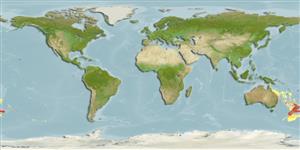
Western Pacific: southern and eastern Australia and New Zealand.
Размер / Вес / Возраст
половая зрелость: Lm ? range ? - ? cm
Max length : 97.0 cm TL самец/пол неопределен; (Ref. 101563)
Краткое описание
определительные ключи | морфология | морфометрия
колючие лучи спинного плавника (общее число) : 0; членистые (мягкие) лучи спинного плавника (общее число) : 0; колючие лучи анального плавника: 0; членистые (мягкие) лучи анального плавника: 0. This species differs from all its congeners except E. caribbeaus, E. goliath, E. menezesi and E. strahani by having 7 pairs of gill pouches and three-cusp multicusps on the anterior and posterior rows of cusps. It differs from E. caribbeaus in number of anterior unicusps (8-11 vs. 11-13), posterior unicusps (7-9 vs. 10-11), total cusps (43-51 vs. 54-58) and prebranchial pores (16-20 vs. 13-15); from E. goliath in number of anterior unicusps (8-11 vs. 11-13), total cusps (43-51 vs. 54) and trunk pores (46-53 vs. 57-58); from E. menezesi in number of posterior unicusps (7-9 vs. 9-12), total cusps (43-51 vs. 52-60), tail pores (10-14 vs. 14-18); from E. strahani by its number of prebranchial pores (16-20 vs. 13-16) (Ref. 85052).
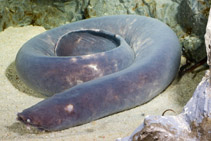
Body shape (shape guide): eel-like.
Occurs on soft bottoms of the continental slope (Ref. 7300). Able to form locally abundant populations and is often associated with inshore reefs (Ref. 85052).
Жизненный цикл и брачное поведение
половая зрелость | размножение | нерест | икра | Плодовитость | личинки
Copulatory organ absent. The gonads of hagfishes are situated in the peritoneal cavity. The ovary is found in the anterior portion of the gonad, and the testis is found in the posterior part. The animal becomes female if the cranial part of the gonad develops or male if the caudal part undergoes differentiation. If none develops, then the animal becomes sterile. If both anterior and posterior parts develop, then the animal becomes a functional hermaphrodite. However, hermaphroditism being characterised as functional needs to be validated by more reproduction studies (Ref. 51361 ).
Fernholm, B., 1998. Hagfish systematics. p. 33-44. In J.M. Jørgensen, J.P. Lomholt, R.E. Weber and H. Malte (eds.) The biology of hagfishes. Chapman & Hall, London. 578 p. (Ref. 31276)
Статус Красного Списка МСОП (Ref. 130435: Version 2025-2 (Global))
Угроза для людей
Harmless
Использование человеком
рыболовство: коммерческий
дополнительная информация
инструменты
Специальные отчеты
Скачать в формате XML
ресурсы в Интернет
Оценки, основанные на моделях
Предпочтительная температура (ссылка
123201): 7.8 - 21, mean 12.3 °C (based on 188 cells).
Индекс филогенетического разнообразия (ссылка
82804): PD
50 = 0.5000 [Uniqueness, from 0.5 = low to 2.0 = high].
Bayesian length-weight: a=0.00295 (0.00160 - 0.00543), b=2.94 (2.77 - 3.11), in cm total length, based on LWR estimates for this species & (Sub)family-body (Ref.
93245).
Трофический уровень (ссылка
69278): 2.0 ±0.00 se; based on food items.
устойчивость к внешним воздействиям (ссылка
120179): низкий, минимальное время удвоения популяции 4.5-14 лет (Fec assumed to be <100).
Уязвимость рыбной ловли (Ref.
59153): High vulnerability (59 of 100).
🛈
Питательные вещества (Ref.
124155): Calcium = 9.68 [2.59, 31.93] mg/100g; Iron = 0.327 [0.115, 0.895] mg/100g; Protein = 2.96 [0.00, 6.83] %; Omega3 = 0.316 [0.118, 0.883] g/100g; Selenium = 16.1 [5.3, 54.3] μg/100g; VitaminA = 9.03 [1.76, 45.12] μg/100g; Zinc = 0.249 [0.118, 0.482] mg/100g (wet weight);