>
Gobiiformes (Gobies) >
Schindleriidae (Infantfishes)
Etymology: Schindleria: Named for ichthyologist Otto Schindler, 1906-1959 (Prof. Dr. Konrad Schindler, pers. comm Dec. 2017).
Eponymy: Otto Schindler (1906–1959) was an ichthyologist at Zoologische Staatssammlung München, Germany, where he was the first post-war Curator of Ichthyology (1949). [...] Otto Schindler (1906–1959) was an ichthyologist at Zoologische Staatssammlung München, Germany, where he was the first post-war Curator of Ichthyology (1949). [...] (Ref. 128868), visit book page.
Umwelt: Milieu / Klimazone / Tiefenbereich / Verbreitungsgebiet
Ökologie
seewasser riff-verbunden; tiefenbereich 0 - 130 m (Ref. 40919). Tropical
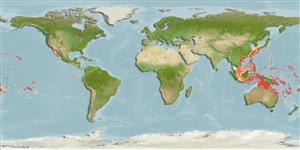
Indo-Pacific from South Africa, Madagascar and India to southern Japan, South China Sea, Australia, Fiji, Marshall Islands, Line Islands, Hawaii, and seamounts of eastern South Pacific.
Größe / Gewicht / Alter
Geschlechtsreife: Lm ? range ? - ? cm
Max length : 2.5 cm TL Männchen/unbestimmt; (Ref. 557); max. veröff. Alter: 0.50 Jahre
Kurzbeschreibung
Bestimmungsschlüssel | Morphologie | Morphometrie
Rückenflossenweichstrahlen (insgesamt) : 16 - 22; Afterflossenweichstrahlen: 10 - 14. Caudal rays are segmented. Gut extends to about two-thirds of the standard length.
Cross section: compressed.
Occur around lagoons and in adjacent waters (Ref. 52496, 58302). Benthopelagic (Ref. 58302). Exhibit extreme paedomorphism (Ref. 52496). Planktonic (Ref. 58302).
Adults with mature gonads while retaining postlarval characters (Ref. 205). Distinct pairing (Ref. 205).
Masuda, H., K. Amaoka, C. Araga, T. Uyeno and T. Yoshino, 1984. The fishes of the Japanese Archipelago. Vol. 1. Tokai University Press, Tokyo, Japan. 437 p. (text). (Ref. 559)
IUCN Rote Liste Status (Ref. 130435: Version 2025-2 (Global))
Bedrohung für Menschen
Harmless
Nutzung durch Menschen
Fischereien: nicht kommerziell
Tools
Zusatzinformationen
Download XML
Internet Quellen
Schätzungen auf der Grundlage von Modellen
Bevorzugte Temperatur (Ref.
123201): 22.2 - 28.9, mean 27.6 °C (based on 872 cells).
Phylogenetischer Diversitätsindex (Ref.
82804): PD
50 = 0.5005 [Uniqueness, from 0.5 = low to 2.0 = high].
Bayesian length-weight: a=0.00389 (0.00180 - 0.00842), b=3.12 (2.94 - 3.30), in cm total length, based on all LWR estimates for this body shape (Ref.
93245).
Trophische Ebene (Ref.
69278): 3.0 ±0.4 se; based on size and trophs of closest relatives
Generation time: 0.1 ( na - na) years. Estimated as median ln(3)/K based on 1
growth studies.
Widerstandsfähigkeit (Ref.
120179): niedrig, Verdopplung der Population dauert 4,5 - 14 Jahre. (tm= 0.25; Fec = 70).
Anfälligkeit der Fischerei (Ref.
59153): Low vulnerability (10 of 100).
🛈
Nährstoffe (Ref.
124155): Calcium = 2180 [114, 144,757] mg/100g; Iron = 21.1 [1.1, 242.7] mg/100g; Protein = 17.5 [12.4, 22.5] %; Omega3 = 0.0807 [, ] g/100g; Selenium = 1660 [10, 184,257] μg/100g; VitaminA = 0.96 [0.00, 349.98] μg/100g; Zinc = 51.9 [4.3, 332.3] mg/100g (wet weight);