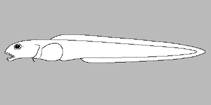
Krusensterniella notabilis, Notable prickled eelpout

You can sponsor this page

Krusensterniella notabilis Schmidt, 1904

Notable prickled eelpout
Envoyez vos Photos et vidéos
Images Google
Image of Krusensterniella notabilis (Notable prickled eelpout)
No image available for this species;
drawing shows typical species in Zoarcidae.

Classification / Noms Noms communs | Synonymes | Catalog of Fishes(Genre, Espèce) | ITIS | CoL | WoRMS | Cloffa

> Perciformes/Zoarcoidei (Eelpouts and pricklebacks) > Zoarcidae (Eelpouts) > Gymnelinae
Etymology: Krusensterniella: Named after the Russian navigator explorer, Admiral I.F. Krusenstern, who led the first Russian circumnavigation (1803– 1806) and visited that part of the Sea of Okhotsk where the type species was found. Of the two Russian-language names 'krusensterniella' (Taranets, 1937) and 'kruzenshternia' (Sheiko and Fedorov, 2000)—the first one has come into scientific use (Ref. 130195)notabilis: Name from Latin 'notabilis' meaning notable.

Environnement : milieu / zone climatique / profondeur / gamme de distribution Écologie

marin démersal; profondeur 24 - 305 m (Ref. 130195). Temperate

Distribution Territoires | Zones FAO | Écosystèmes | Occurrences | Carte par point | Introductions | Faunafri

Northwest Pacific: Sea of Okhotsk, the Kuril Islands, and the Tatar Strait of the Sea of Japan.

Taille / Poids / Âge

Maturité: Lm ?  range ? - ? cm
Max length : 18.9 cm TL mâle / non sexé; (Ref. 130195)

Biologie     Glossaire (ex. epibenthic)

The life history of this species has not been studied, but it may serve as an additionary food item for demersal predators, where one specimen was found in the stomach of the stingray Bathyraja sp. caught in the area of Simushir Island (Ref. 130195). Minimum depth (24 m) from Ref. 50550.

Cycle de vie et comportement reproducteur Maturité | Reproduction | Frai | Œufs | Fécondité | Larves

Référence principale Téléchargez vos références | Références | Coordinateur | Collaborateurs

Chernova, N.V., 2022. Review of prickled eelpouts of genus Krusensterniella (Zoarcidae) describing three new species from the far-eastern seas. J. Ichthyol. 62(2):153-172. (Ref. 130195)

Statut dans la liste rouge de l'IUCN (Ref. 130435: Version 2025-2 (Global))


CITES

Not Evaluated

CMS (Ref. 116361)

Not Evaluated

Menace pour l'homme

  Harmless


Utilisations par l'homme

Pêcheries: sans intérêt
FAO - Publication: search | FishSource |

Plus d'informations

Écologie trophique
Aliments (proies)
Composition du régime alimentaire
Consommation alimentaire
Rations alimentaires
Prédateurs
Écologie
Écologie
Dynamique des populations
Paramètres de croissance
Âges / tailles maximales
Longueur-poids rel.
Rel. longueur-longueur.
Fréquences de longueurs
Conversion de masse
Recrutement
Abondance
Cycle de vie
Reproduction
Maturité
Maturité/épines rel.
Fécondité
Frai
Agrégats de frai
Œufs
Développement de l'œuf
Larves
Dynamique des populations larvaires
Distribution
Territoires
Zones FAO
Écosystèmes
Occurrences
Introductions
BRUVS - Vidéos
Anatomie
Surface branchiale
Cerveau
Otolithe
Physiologie
Composition corporelle
Nutriments
Consommation d'oxygène
Type de natation
Vitesse de nage
Pigments visuels
Son de poisson
Maladies et parasites
Toxicité (CL50)
Génétique
génôme
Génétique
Hétérozygotie
Héritabilité
Diversité génétique
Liées à l'homme
Systèmes d'aquaculture
Profils d'aquaculture
Souches
Cas de ciguatera
Timbres, pièces de monnaie, divers
Sensibilisation
Collaborateurs
Taxonomie
Noms communs
Synonymes
Morphologie
Morphométrie
Images
Références
Références

Outils

Articles particuliers

Télécharger en XML

Sources Internet

AFORO (otoliths) | Aquatic Commons | BHL | Cloffa | Websites from users | FishWatcher | CISTI | Catalog of Fishes: Genre, Espèce | DiscoverLife | ECOTOX | FAO - Publication: search | Faunafri | Fishipedia | Fishtrace | GloBI | Google Books | Google Scholar | Google | IGFA World Record | OneZoom | Open Tree of Life | Otolith Atlas of Taiwan Fishes | PubMed | Reef Life Survey | Socotra Atlas | TreeBase | Arbre de Vie | Wikipedia: aller à, chercher | World Records Freshwater Fishing | Zoobank | Zoological Record

Estimations basées sur des modèles

Indice de diversité phylogénétique (Réf. 82804):  PD50 = 0.5039   [Uniqueness, from 0.5 = low to 2.0 = high].
Bayesian length-weight: a=0.00324 (0.00135 - 0.00773), b=3.15 (2.94 - 3.36), in cm total length, based on LWR estimates for this (Sub)family-body shape (Ref. 93245).
Niveau trophique (Réf. 69278):  3.2   ±0.4 se; based on size and trophs of closest relatives
Résilience (Réf. 120179):  Milieu, temps minimum de doublement de population : 1,4 à 4,4 années (Preliminary K or Fecundity.).
Vulnérabilité de la pêche (Ref. 59153):  Low vulnerability (10 of 100). 🛈