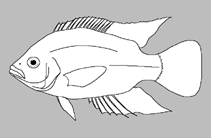
>
Cichliformes (Cichlids, convict blennies) >
Cichlidae (Cichlids) > Pseudocrenilabrinae
Etymology: Pseudotropheus: Greek, pseudes = false + Greek, tropaion = defeat, a memorial of a fighting war, trophy; because of their specialized teeth were such an obvious feeding adaptation (Ref. 45335).
Eponymy: David Livingstone (1813–1873) was a Scottish doctor and missionary, and undoubtedly the most famous African explorer of all time. [...] (Ref. 128868), visit book page.
More on author: Boulenger.
Περιβάλλον: περιβάλλον / κλιματική ζώνη / εύρος βάθους / εύρος διανομής
Οικολογία
; Γλυκού νερού βενθικό(ς); pH range: 8.0 - 9.0; dH range: 12 - 20; εύρος βάθους 2 - 50 m. Tropical; 22°C - 26°C (Ref. 2060); 13°S - 15°S
Africa: Lake Malawi (Ref. 119458), common in the southeastern and southwestern arms of the lake (Ref. 5684).
Μέγεθος / Βάρος / Ηλικία
Γεννητική Ωρίμανση: Lm ? range ? - ? cm
Max length : 15.0 cm TL αρσενικό/απροσδιόριστο; (Ref. 5684)
Σύντομη περιγραφή
Κλείδες προσδιορισμού | Μορφολογία | Μορφομετρία
Ραχιαίες άκανθες (συνολικά) : 17 - 19; Μαλακές ραχιαίες ακτίνες (συνολικά) : 9 - 10; Εδρικές άκανθες: 3; Μαλακές εδρικές ακτίνες: 8 - 9. Diagnosis: This species is distinguished from all other members in Pseudotropheus, except P. crabro, P. demasoni, and P. saulosi, by the presence of five or fewer vertical bars below the dorsal fin; most Pseudotropheus species either have no bars or have greater than five below the dorsal fin (Ref. 119458). It is distinguished from P. crabro, P. demasoni, and P. saulosi by a pale yellow to hyaline dorsal fin vs. dorsal fin heavily pigmented with black (Ref. 119458).
Body shape (shape guide): fusiform / normal.
Lives mainly over sand where it finds refuge in the empty shells of the gastropod, Lanistes nyassanus. Also found in intermediate habitats and rarely over rocks. Usually territorial over gastropod shells. When found away from its shell, it is usually solitary or in small groups of less than 5 individuals. Feeds from sand, taking epipelic algae (Ref. 6256).
Κύκλος ζωής και συμπεριφορά ζευγαρώματος
Γεννητική Ωρίμανση | Αναπαραγωγή | Γεννοβολία | Αβγά | Γονιμότητα | Προνύμφες
Females are mouthbrooders.
Stauffer, J.R. Jr., A.F. Konings and T.M. Ryan, 2016. Redescription of Pseudotropheus livingstonii and Pseudotropheus elegans from Lake Malawi, Africa. Zootaxa 4154(2):169-178. (Ref. 119458)
Κατάσταση Κόκκινου Καταλόγου IUCN (Ref. 130435: Version 2025-2 (Global))
Απειλή για τον άνθρωπο
Harmless
Ανθρώπινες χρήσεις
Ενυδρείο: Εμπορικό(ά)
Εργαλεία
Ειδικές εκθέσεις
Λήψη XML
Διαδικτυακές πηγές
Εκτιμήσεις βάσει μοντέλων
Δείκτης φυλογενετικής ποικιλότητας (Αναφ.
82804): PD
50 = 0.5000 [Uniqueness, from 0.5 = low to 2.0 = high].
Bayesian length-weight: a=0.01445 (0.00671 - 0.03113), b=2.99 (2.82 - 3.16), in cm total length, based on LWR estimates for this (Sub)family-body shape (Ref.
93245).
Τροφικό Επίπεδο (Αναφ.
69278): 3.7 ±0.1 se; based on diet studies.
Ελαστικότητα (Αναφ.
120179): Μεσαίο(α), ελάχιστος χρόνος για διπλασιασμό πληθυσμού 1,4 - 4,4 έτη (Fec<1000).
Ευπάθεια στην αλιεία (Ref.
59153): Low vulnerability (10 of 100).
🛈