>
Siluriformes (Catfishes) >
Clariidae (Airbreathing catfishes)
Etymology: Clarias: Greek, chlaros = lively, in reference to the ability of the fish to live for a long time out of water.
More on author: Boulenger.
Environnement : milieu / zone climatique / profondeur / gamme de distribution
Écologie
; eau douce démersal. Tropical; 9°N - 1°S
Africa: Cross (Nigeria), Sanaga, Nyong, Lobe and Kribi (Cameroon), the Ntem (Cameroon and Gabon), Mbini/Woleu (Gabon and Equatorial Guinea), Komo (Gabon) (Ref. 81644) and the Ogowe (Gabon and Republic of Congo)(Ref. 248, 92841). Also in the middle Congo River basin in the rivers Ja (Dja) and Sangha (Ref. 248, 92841). In southeast Nigeria known from the Osse, Niger delta and Cross (Ref. 57129).
Taille / Poids / Âge
Maturité: Lm ? range ? - ? cm
Max length : 48.3 cm TL mâle / non sexé; (Ref. 57129)
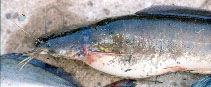
Épines dorsales (Total) : 0; Rayons mous dorsaux (Total) : 70 - 86; Rayons mous anaux: 54 - 71; Vertèbres: 58 - 65. Diagnosis: head relatively long (Ref. 248, 57129) and flattened, its length 24.8-28.6% SL (mean 26.2)(Ref. 57129, 81644). Frontal fontanel short and wide (Ref. 57129, 81644), "sole-shaped" (Ref. 248), 1.5 times as long as wide (Ref. 81644). Lateral cephalic bones (dermosphenotic and supraorbital) becoming contiguous already in young individuals (between 70 and 80 mm SL)(Ref. 248, 57129, 81644). First gill arch with 11-19 gill rakers (Ref. 57129, 81644). Color pattern usually uniform, occasionally a marbled pattern consisting of various dark brown spots on a light-brown background; head broad and pointed in dorsal outline; tooth plates broad; suprabranchial organ well developed although not completely filling the chamber (Ref. 248). Vomerine tooth band a little less short than premaxillary tooth band; pectoral spine serrate only along anterior margin; flank neuromasts arranged in a regular pattern (Ref. 81644).
Coloration: no information on colour in life (Ref. 57129, 81644). Most preserved specimens uniformly coloured: back and sides light to dark brown, belly beige-white; some specimens have a marbled pattern, with numerous black spots against a lighter background on back and sides, while the belly is beige to yellowish (Ref. 57129, 81644).
Body shape (shape guide): elongated; Cross section: oval.
Facultative air-breathing (Ref. 126274); Ecology, food and breeding: unknown (Ref. 248).
Cycle de vie et comportement reproducteur
Maturité | Reproduction | Frai | Œufs | Fécondité | Larves
Teugels, G.G., 1986. A systematic revision of the African species of the genus Clarias (Pisces; Clariidae). Ann. Mus. R. Afr. Centr., Sci. Zool., 247:199 p. (Ref. 248)
Statut dans la liste rouge de l'IUCN (Ref. 130435: Version 2025-2 (Global))
Menace pour l'homme
Harmless
Utilisations par l'homme
Pêcheries: sans intérêt
Outils
Articles particuliers
Télécharger en XML
Sources Internet
Estimations basées sur des modèles
Indice de diversité phylogénétique (Réf.
82804): PD
50 = 0.5000 [Uniqueness, from 0.5 = low to 2.0 = high].
Bayesian length-weight: a=0.00776 (0.00372 - 0.01620), b=2.96 (2.79 - 3.13), in cm total length, based on LWR estimates for this Genus-body shape (Ref.
93245).
Niveau trophique (Réf.
69278): 3.5 ±0.5 se; based on size and trophs of closest relatives
Résilience (Réf.
120179): Milieu, temps minimum de doublement de population : 1,4 à 4,4 années (Fec < 10,000).
Vulnérabilité de la pêche (Ref.
59153): Moderate vulnerability (38 of 100).
🛈