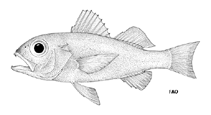
Ambiente: milieu / zona climatica / distribuzione batimetrica / gamma di distribuzione
Ecologia
marino batipelagico; distribuzione batimetrica 100 - 570 m (Ref. 123567). Deep-water
Western Indian Ocean: off southern Mozambique Channel to off Eastern Cape of South Africa.
Dimensione / Peso / Età
Maturità: Lm ? range ? - ? cm
Max length : 21.0 cm SL maschio/sesso non determinato; (Ref. 2710)
Breve descrizione
Chiavi di identificazione | Morfologia | Morfometria
Spine dorsali (totale) : 10; Raggi dorsali molli (totale) : 10; Spine anali: 3; Raggi anali molli: 7 - 8. This species is distinguished from its congeners by the following set of characters: basioccipital foramen present (vs. absent); proximal middle radial of anal-fin pterygiophore slender with trough on anterodorsal portion (vs. no trough); lateral line scales 36-42 (vs. 44-48 in N. atlanticus, 47-51 in N. pacificus); only cycloid scales on body (vs. ctenoid and cycloid in N. atlanticus); small canine teeth on side of lower jaw (vs. villiform teeth in N. atlanticus) (Ref. 55728).
Body shape (shape guide): elongated; Cross section: compressed.
Marketed fresh or made into fishmeal (Ref. 3288).
Ciclo vitale e comportamento di accoppiamento
Maturità | Riproduzione | Deposizione | Uova | Fecondità | Larve
Yamanoue, Y., 2016. Revision of the genus Verilus (Perciformes: Acropomatidae) with a description of a new species. J. Fish Biol., 89(5):2375-2398. (Ref. 123567)
Stato della Lista Rossa IUCN (Ref. 130435: Version 2025-2 (Global))
Minaccia per l'uomo
Harmless
Usi umani
Strumenti
Rapporti speciali
Scarica XML
Fonti Internet
Stime basate su modelli
Temperatura preferita (Fonte Biblio.
123201): 12.7 - 18.8, mean 15.3 °C (based on 57 cells).
Indice di diversità filogenetica (Fonte Biblio.
82804): PD
50 = 0.5039 [Uniqueness, from 0.5 = low to 2.0 = high].
Bayesian length-weight: a=0.00468 (0.00181 - 0.01207), b=3.12 (2.89 - 3.35), in cm total length, based on LWR estimates for this (Sub)family-body shape (Ref.
93245).
Livello trofico (Fonte Biblio.
69278): 3.9 ±0.6 se; based on size and trophs of closest relatives
Vulnerabilità della pesca (Ref.
59153): Low vulnerability (16 of 100).
🛈