>
Cypriniformes (Carps) >
Cyprinidae (Minnows or carps) > Barbinae
Eponymy: Dr Philip Lutley Sclater (1829–1913) was a British lawyer, zoologist and, in particular, ornithologist. [...] (Ref. 128868), visit book page.
More on author: Günther.
Milieu: milieu / Klimaatzone / Diepte / verspreidingsgebied
Ecologie
; zoet water benthopelagisch; potamodroom (Ref. 138297). Temperate
Europe: Southern Spain and Portugal from Segura to Mira drainages.
Lengte bij maturiteit / Grootte / Gewicht / Leeftijd
Maturiteit: Lm 13.5, range 11 - 16 cm
Max length : 49.5 cm FL mannelijk / geslacht onbekend; (Ref. 59098); max. gerapporteerde leeftijd: 18 Jaren (Ref. 59043)
Korte beschrijving
Determinatiesleutels | Morfologie | Morfometrie
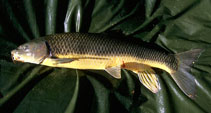
Diagnosed from other species of Barbus and Luciobarbus in Iberian Peninsula by having the following characters: sharp contrast between dark back and whitish belly in adults larger than 30 cm SL; caudal peduncle stout, depth about 1.2-1.4 times in its length; head length 24-29% SL; lateral line with 42-45 + 3 scales; last simple dorsal ray hardened and rigid on 1/2-3/4 of its length, with small serrae posteriorly along most of length; lower lip with or mostly without median lobe; and lower jaw tip covered by lower lip (Ref. 59043).
Body shape (shape guide): fusiform / normal.
Adults occur in water bodies on low-lying plains, with little current (Ref. 26100). Found in a variety of habitats, most abundant in large rivers and streams with slow to moderate current. Avoids upper, cold water streams. Widely distributed and locally abundant, but populations are greatly fragmented and several of them are potentially threatened as many small streams turn dry during summer. Maximum life span is about 18 years (Ref. 59043).
Females spawned 2 batches of eggs during the reproductive season. End of the spawning season, coincided with decreased oxygen saturation.
Kottelat, M. and J. Freyhof, 2007. Handbook of European freshwater fishes. Publications Kottelat, Cornol and Freyhof, Berlin. 646 pp. (Ref. 59043)
Status op de Rode Lijst van het IUCN (Ref. 130435: Version 2025-2 (Global))
Gevaar voor de mens
Harmless
Gebruik door de mens
Sportvis: ja
Tools
Speciale rapporten
Download XML
Internetbronnen
Schattingen op basis van modellen
Fylogenetische diversiteitsindex (Ref.
82804): PD
50 = 0.5000 [Uniqueness, from 0.5 = low to 2.0 = high].
Bayesian length-weight: a=0.00977 (0.00777 - 0.01230), b=2.98 (2.94 - 3.02), in cm total length, based on LWR estimates for this species (Ref.
93245).
Trofisch niveau (Ref.
69278): 2.6 ±0.24 se; based on food items.
Generation time: 15.9 ( na - na) years. Estimated as median ln(3)/K based on 2
growth studies.
Weerstandsvermogen (Ref.
120179): laag, minimale populatieverdubbelingstijd 4,5-14 jaar (tm=4-5; tmax=11).
Kwetsbaarheid van de visserij (Ref.
59153): Moderate vulnerability (42 of 100).
🛈