>
Cichliformes (Cichlids, convict blennies) >
Cichlidae (Cichlids) > Pseudocrenilabrinae
Etymology: Maylandia: In honour of Hans J. Mayland, German ictiologist (Ref. 45335).
Eponymy: Hans-Joachim Mayland (1928–2004) was a German ichthyologist, aquarist, photographer and writer. [...] Aurora was the Roman goddess of the dawn. In the case of the goby, the name refers to the pattern on its caudal fin being ‘…reminiscent of the rising sun’. The name is often applied to species with pink/yellow colouration. (Ref. 128868), visit book page.
Milieu: milieu / Klimaatzone / Diepte / verspreidingsgebied
Ecologie
; zoet water demersaal; pH range: 7.5 - 8.5; dH range: 12 - 30; diepte 2 - 12 m (Ref. 9605), usually 2 - 5 m (Ref. 6256). Tropical; 24°C - 26°C (Ref. 1672); 12°S - 15°S
Africa: Lake Malawi at Likoma Island (Ref. 6256, 86409) and along the coast of Mozambique between Mara Point and Tumbi Point and south near N'kolongwe (Ref. 86409). Populations have been transplanted in Lake Malawi to Otter Point and Thumbi West Island (Ref. 6256, 86409).
Grootte / Gewicht / Leeftijd
Maturiteit: Lm ? range ? - ? cm
Max length : 8.7 cm SL mannelijk / geslacht onbekend; (Ref. 5684); 8.0 cm SL (female)
Korte beschrijving
Determinatiesleutels | Morfologie | Morfometrie
Dorsale stekels (totaal) : 17 - 19; Dorsale zachte stralen (totaal) : 8 - 10; Anale stekels: 3 - 4; Anale zachte stralen: 7 - 8. Diagnosis: The lack of a black submarginal band in the dorsal fin, a yellow ventral half of the head, breast, and dorsal fin, and the light-brown coloured females that have yellow fin-margins distinguish Maylandia aurora from most members of the genus, except M. hajomaylandi, M. chrysomallos, and M. xanthos; it differs from M. hajomaylandi and M. chrysomallos by fewer, faint, vertical bars below the dorsal fin, 6 vs. 7-9; and from M. xanthos by a shorter lower jaw, 28.4-33.5% of head length vs. 34.6-36.7% (Ref. 86409).
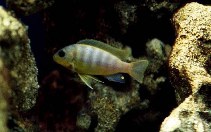
Colouration: Lateral body colouration blue dorsally in males from likoma Island, Mara Point North, and N'kolongwe, but brown dorsally in males from Mbweca and Tumbi Point, with anterior portion of scales sky-blue and 6 faint blue bars below dorsal fin; caudal peduncle dark blue; yellow belly and breast fading to light blue towards anal fin; head sky-blue with preorbital, ventral half of cheek, operculum and preoperculum yellow; dark yellow/green opercular spot; gular yellow; dorsal fin yellow with submarginal sky-blue band and sky-blue blotches throughout; caudal-fin rays yellow with light-blue membranes; anal fin pale blue to pale yellow with one ocellus; pelvic fin with light-blue leading edge, remaining yellow; pectoral-fin rays pale yellow and membranes clear (Ref. 86409). Female lateral ground colouration pale blue with center of scales orange/brown; belly white; head brown; cheek and operculum with purple highlights; gray/black opercular spot; white gular; dorsal fin brown with brown lappets; caudal-fin rays brown with clear membranes; anal fin gray proximally and brown distally with single small orange/brown ocellus; pelvic finwith white leading edge; first two rays and membranes brown, remainder clear; pectoral fin clear (Ref. 86409).
Body shape (shape guide): fusiform / normal.
Found in the intermediate zones of Lake Malawi, being particularly common along the rock-sand interface; occasionally it occurs in purely rocky habitats which are close to sand; most numerous between 2 and 5 m depth (Ref. 6256). Territories are held by males, usually over the upper surfaces of medium-sized and large rocks, but a small proportion of males occupy less prominent sites and some defend areas at the base of rocks where they dig sand-scrape nests; females, juveniles and non-territorial adult males occur singly or in groups of up to 30 individuals (Ref. 6256).
Levenscyclus en paargedrag
Maturiteit | Voortplanting | Paaien | Eieren | Fecunditeit | Larven
Produces 40-70 eggs.
Ciccotto, P.J., A. Konings and J.R. Stauffer Jr., 2011. Descriptions of five new species in the genus Metriaclima (Teleostei: Cichlidae) from Lake Malaŵi, Africa. Zootaxa 2738:1-25. (Ref. 86409)
Status op de Rode Lijst van het IUCN (Ref. 130435: Version 2025-2 (Global))
Gevaar voor de mens
Harmless
Gebruik door de mens
Visserij: commercieel; Aquarium: Commercieel
Tools
Speciale rapporten
Download XML
Internetbronnen
Schattingen op basis van modellen
Fylogenetische diversiteitsindex (Ref.
82804): PD
50 = 0.5000 [Uniqueness, from 0.5 = low to 2.0 = high].
Bayesian length-weight: a=0.01445 (0.00671 - 0.03113), b=2.99 (2.82 - 3.16), in cm total length, based on LWR estimates for this (Sub)family-body shape (Ref.
93245).
Trofisch niveau (Ref.
69278): 2.0 ±0.0 se; based on diet studies.
Weerstandsvermogen (Ref.
120179): Hoog, minimale populatieverdubbelingstijd minder dan 15 maanden (Preliminary K or Fecundity.).
Kwetsbaarheid van de visserij (Ref.
59153): Low vulnerability (10 of 100).
🛈