>
Perciformes/Uranoscopoidei (Sand dwellers) >
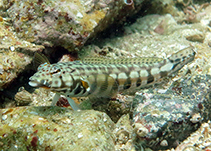
Pinguipedidae (Sandperches)
Etymology: Parapercis: Greek, para = the side of + Greek, perke = perch (Ref. 45335).
Eponymy: Dr Toshiji Kamohara (1901–1972) was an ichthyologist who graduated from Tokyo Imperial University (1926). [...] (Ref. 128868), visit book page.
More on author: Schultz.
Miljö: miljö / Klimatzon / djupintervall / distributionsområde
Ekologi
marina bottenlevande. Subtropical
Northwest Pacific: Japan, Taiwan and Hong Kong.
Storlek / Vikt / Ålder
Könsmognad: Lm ? range ? - ? cm
Max length : 20.0 cm SL hane/ej könsbestämd; (Ref. 559)
Feeds on crabs and fishes (Ref. 9137).
Livscykel och parningsbeteende
Könsmognad | Reproduktion | Lek | Ägg | Fekunditet | Larver
Masuda, H., K. Amaoka, C. Araga, T. Uyeno and T. Yoshino, 1984. The fishes of the Japanese Archipelago. Vol. 1. Tokai University Press, Tokyo, Japan. 437 p. (text). (Ref. 559)
Status på IUCN:s rödlista (Ref. 130435: Version 2025-2 (Global))
Hot mot människor
Harmless
Mänskliga användningsområden
Verktyg
Särskilda rapporter
Ladda ner XML
Internet-källor
Uppskattningar baserade på modeller
Index för fylogenetisk mångfald (Ref.
82804): PD
50 = 0.5000 [Uniqueness, from 0.5 = low to 2.0 = high].
Bayesian length-weight: a=0.00692 (0.00314 - 0.01524), b=3.06 (2.88 - 3.24), in cm total length, based on LWR estimates for this Genus-body shape (Ref.
93245).
Trofisk nivå (Ref.
69278): 4.0 ±0.67 se; based on food items.
Resiliens (Ref.
120179): Mellan, lägsta populationsfördubblingstid 1,4-4,4 år (Preliminary K or Fecundity.).
Sårbarhet i fisket (Ref.
59153): Low vulnerability (14 of 100).
🛈