>
Eupercaria/misc (Various families in series Eupercaria) >
Labridae (Wrasses) > Hypsigenyinae
Etymology: Bodianus: Bodianus after Bodiano or Pudiano, from the Portuguese pudor, meaning modesty (Jordan & Evermann, 1896); cylindriatus: Name from the masculine Latin noun 'cylinder' for roller and 'atus' for having the nature of, apparently in reference to the narrow body. The subgenus Priobodianus from the Latin prior for earlier or former and Portuguese name 'Bodiano' (derived from Bodianus); referring to the primitive features in the species allocated to this subgenus and the hypothesized early if not initial divergence of this line within the evolution of the genus.
More on author: Tanaka.
Umwelt: Milieu / Klimazone / Tiefenbereich / Verbreitungsgebiet
Ökologie
seewasser riff-verbunden; tiefenbereich 250 - 510 m (Ref. 58302). Temperate
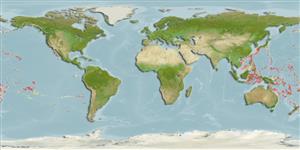
Western Pacific: Japan. More recently reported from the Chesterfield Islands (Ref. 11897). Reported from the Hawaiian Islands (Ref. 58302).
Größe / Gewicht / Alter
Geschlechtsreife: Lm ? range ? - ? cm
Max length : 14.2 cm SL Männchen/unbestimmt; (Ref. 75973)
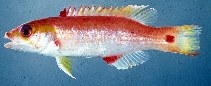
Rückenflossenstacheln (insgesamt) : 12; Rückenflossenweichstrahlen (insgesamt) : 10. This species has the following characters: D XII, 10; caudal fin rays 10 + 12 + 10; pectoral-fin rays ii, 14-15; lateral line scales 30-31 (rarely 31); scales above lateral line 2-3; scales below lateral line 8½-10½; predorsal scales 25-27; total gill rakers 13-17; upper jaw have prominent anterior canines of similar size; dental ridge is low, 2 consecutive rows of shorter canines, the first with 4 teeth slightly longer than 4-5 in second row; posterior end of upper jaw with moderately large canine; lower jaw with first prominent anterior canine ca ½ - 2/3 size of second, directed anterodorsally and slightly laterally; dental ridge low with 2 series of smaller caniniform teeth laterally, the first with about 4 teeth slightly longer than 6-7 in second; similar sized lateral teeth in both jaws; shallow body, 21.3-25.5% SL; snout, 7.6-10.4% SL; short head, 31.8-34.2% SL; first soft ray of pelvic fin not prolonged as filament, at most reaching just beyond anus (Ref. 75973).
Body shape (shape guide): fusiform / normal.
Benthopelagic over hard substrates (Ref. 58302). Oviparous, distinct pairing during breeding (Ref. 205).
Lebenszyklus und Paarungsverhalten
Geschlechtsreife | Fortpflanzung | Ablaichen | Eier | Fruchtbarkeit | Larven
Oviparous, distinct pairing during breeding (Ref. 205).
Gomon, M.F., 2006. A revision of the labrid fish genus Bodianus with descriptions of eight new species. Rec. Aust. Mus. Suppl. 30:1-133. (Ref. 75973)
IUCN Rote Liste Status (Ref. 130435: Version 2025-2 (Global))
Bedrohung für Menschen
Harmless
Nutzung durch Menschen
Tools
Zusatzinformationen
Download XML
Internet Quellen
Schätzungen auf der Grundlage von Modellen
Bevorzugte Temperatur (Ref.
123201): 7.1 - 16.9, mean 11.5 °C (based on 102 cells).
Phylogenetischer Diversitätsindex (Ref.
82804): PD
50 = 0.5000 [Uniqueness, from 0.5 = low to 2.0 = high].
Bayesian length-weight: a=0.01047 (0.00493 - 0.02225), b=3.08 (2.90 - 3.26), in cm total length, based on LWR estimates for this Genus-body shape (Ref.
93245).
Trophische Ebene (Ref.
69278): 3.4 ±0.4 se; based on size and trophs of closest relatives
Widerstandsfähigkeit (Ref.
120179): hoch, Verdopplung der Population dauert weniger als 15 Monate. (Preliminary K or Fecundity.).
Anfälligkeit der Fischerei (Ref.
59153): Low vulnerability (10 of 100).
🛈