>
Siluriformes (Catfishes) >
Loricariidae (Armored catfishes) > Hypostominae
Etymology: Hypostomus: Greek, hypo = under + Greek, stoma = mouth (Ref. 45335).
Eponymy: Dr Philibert Commerson (1727–1773) was known as ‘doctor, botanist and naturalist of the King’. [...] (Ref. 128868), visit book page.
More on author: Valenciennes.
Ambiente: milieu / zona climática / intervalo de profundidade / gama de distribuição
Ecologia
; Água doce demersal; potamódromo (Ref. 51243). Subtropical
South America: Lower Paraná including the Iguazú, Paraguay, Río de la Plata and Dulce Rivers.
Tamanho / Peso / Idade
Maturidade: Lm ? range ? - ? cm
Max length : 60.5 cm TL macho/indeterminado; (Ref. 79585); peso máx. Publicado: 1.8 kg (Ref. 79585)
Descrição breve
Chaves de identificação | Morfologia | Morfometria
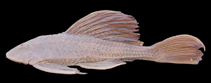
Espinhos dorsais (total) : 2; Raios dorsais moles (total) : 7; Espinhos anais: 1; Raios anais moles: 4. This species is distinguished by the following characters: teeth bifid teeth (vs. spoon-shaped); dark spots on a light background (vs light spots on a dark background or not spotted); 4 rough lateral ridges on flanks (vs. absent); 26-29 lateral series plates (vs. < 28 in several species, 31-32 in H. laplatae); 1-2 plates bordering posterior margin of the supraoccipital bone (vs. 3-4 in H. laplatae); differs from H. affinis, H. punctatus, H. ancistroides by having inter-dorsal distance 14.4-19.5% in SL (vs. 18.9-21.0%); head depth 49.0-71.6% in HL (vs. 48.2-49.9); differs from H. spiniger by having fine lateral ridges with odontodes posteriorly inclined (vs. large lateral ridges with odontodes in all directions), weak lateral ridges in caudal peduncle (vs. strong), mid lateral ridge from first plate (vs. ridge from 2nd or 3rd plates); adult of this species (> 12.0 cm SL) can be distinguished from adult H. spiniger by having a strong ridge on temporal plate (vs. very week) (Ref. 121236).
Body shape (shape guide): elongated; Cross section: angular.
Facultative air-breathing in the genus (Ref. 126274); Occurs in rivers where substrate from which specimens were obtained was composed chiefly of muddy sand. This species was found in moderately oxygenated waters (6.1-9.1 mg/l) with moderate current; water turbidity 23.7-442 NTU, conductivity 1.087-2.654 μS/cm, pH 7.2-9.2, and temperature 16.8-27.8°C (Ref. 121236).
Ciclo de vida e comportamento de acasalamento
Maturidade | Reprodução | Desova | Ovos | Fecundidade | Larvas
Cardoso, Y.P., F. Brancolini, L. Protogino, A. Paracampo, S. Bogan, P. Posadas and J.I. Montoya-Burgos, 2019. An integrated approach clarifies the cryptic diversity in Hypostomus Lacépède 1803 from the Lower La Plata Basin. Anais da Academia Brasileira de Ciéncias 91(2):e20180131: [1-25]. (Ref. 121236)
Categoria na Lista Vermelha da IUCN (Ref. 130435: Version 2025-2 (Global))
Ameaça para o homem
Harmless
Utilização humana
Pescarias: espécies comerciais; Aquário: Espécies comerciais
Ferramentas
Relatórios especiais
Descarregue XML
Fontes da internet
Estimativas baseadas em modelos
Índice de diversidade filogenética (Ref.
82804): PD
50 = 0.5000 [Uniqueness, from 0.5 = low to 2.0 = high].
Bayesian length-weight: a=0.01778 (0.01490 - 0.02122), b=2.95 (2.92 - 2.98), in cm total length, based on LWR estimates for this species (Ref.
93245).
Resiliência (Ref.
120179): Muito baixo, tempo mínimo de duplicação da população maior que 14 anos (Preliminary K or Fecundity.).
Vulnerabilidade da pesca (Ref.
59153): Moderate vulnerability (44 of 100).
🛈