>
Acropomatiformes (Oceanic basses) >
Epigonidae (Deepwater cardinalfishes)
Etymology: Epigonus: Greek, epi = over, in front + Greek, gonio = angle (Ref. 45335); ctenolepis: Named for its ctenoid scales on the lateral line.
Milieu: milieu / Klimaatzone / Diepte / verspreidingsgebied
Ecologie
marien bathydemersaal; diepte 100 - 1200 m (Ref. 559). Deep-water
Northwest Pacific: Kumanonada Sea, Japan.
Grootte / Gewicht / Leeftijd
Maturiteit: Lm ? range ? - ? cm
Max length : 10.0 cm SL mannelijk / geslacht onbekend; (Ref. 559)
Korte beschrijving
Determinatiesleutels | Morfologie | Morfometrie
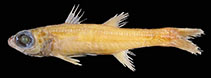
Dorsale stekels (totaal) : 8; Dorsale zachte stralen (totaal) : 10; Anale stekels: 2; Anale zachte stralen: 9; Wervels: 25. Well-developed opercular spine present. Body is noticeably flattened laterally, its greatest width is 70-80 percent of greatest depth. Length of the second spine on the first dorsal fin is 23-26 percent of head length (Ref. 31632). Eighth rib below tenth vertebra absent. Ctenoid scales on lateral line; about 12-14 transverse scales below lateral line. Eyes large, oval; mouth oblique (Ref. 35777).
Body shape (shape guide): fusiform / normal; Cross section: oval.
A mesobenthic-pelagic species living mainly above the bottom (Ref. 31632). Found on or near continental slopes and seamounts.
Levenscyclus en paargedrag
Maturiteit | Voortplanting | Paaien | Eieren | Fecunditeit | Larven
Mochizuki, K. and K. Shirakihara, 1983. A new and a rare apogonid species of the genus Epigonus from Japan. Japan. J. Ichthyol. 30(3):199-207. (Ref. 35777)
Status op de Rode Lijst van het IUCN (Ref. 130435: Version 2025-2 (Global))
Gevaar voor de mens
Harmless
Gebruik door de mens
Visserij: van potentieel belang
Tools
Speciale rapporten
Download XML
Internetbronnen
Schattingen op basis van modellen
Fylogenetische diversiteitsindex (Ref.
82804): PD
50 = 0.5000 [Uniqueness, from 0.5 = low to 2.0 = high].
Bayesian length-weight: a=0.01202 (0.00571 - 0.02532), b=3.02 (2.84 - 3.20), in cm total length, based on LWR estimates for this Genus-body shape (Ref.
93245).
Trofisch niveau (Ref.
69278): 3.4 ±0.5 se; based on size and trophs of closest relatives
Weerstandsvermogen (Ref.
120179): Hoog, minimale populatieverdubbelingstijd minder dan 15 maanden (Preliminary K or Fecundity.).
Kwetsbaarheid van de visserij (Ref.
59153): Low vulnerability (10 of 100).
🛈