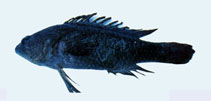
>
Ovalentaria/misc (Various families in series Ovalentaria) >
Plesiopidae (Roundheads) > Plesiopinae
Etymology: Plesiops: Greek, plesios = near + Greek, ops = appearance (Ref. 45335).
Eponymy: Mr Kosaku Nakahara (no other information is given in the etymology), who was “…fortunate enough to obtain this rare species” from a fishmonger at Tomita, Ise Province, Japan. (Ref. 128868), visit book page.
More on author: Tanaka.
Milieu: milieu / Klimaatzone / Diepte / verspreidingsgebied
Ecologie
marien rifbewoner. Temperate
Northwest Pacific: eastern coast of central Japan, from Izu Islands to Kochi. Also reported from Taiwan.
Grootte / Gewicht / Leeftijd
Maturiteit: Lm ? range ? - ? cm
Max length : 14.0 cm TL mannelijk / geslacht onbekend; (Ref. 559)
Adults are found under stones (Ref. 9137). Eggs are guarded by the male parent (Ref. 205).
Levenscyclus en paargedrag
Maturiteit | Voortplanting | Paaien | Eieren | Fecunditeit | Larven
Eggs are guarded by the male parent (Ref. 205).
Mooi, R.D., 1995. Revision, phylogeny, and discussion of biology and biogeography of the fish genus Plesiops (Perciformes: Plesiopsidae). Life Sci. Contrib. No. 159, 108 p. (Ref. 27772)
Status op de Rode Lijst van het IUCN (Ref. 130435: Version 2025-2 (Global))
Gevaar voor de mens
Harmless
Gebruik door de mens
Tools
Fatal error: Uncaught mysqli_sql_exception: Too many connections in /var/www/html/includes/speciessummary.lib.php:1888
Stack trace:
#0 /var/www/html/includes/speciessummary.lib.php(1888): mysqli->__construct('mysql', 'fbuser', Object(SensitiveParameterValue), 'fbquizv2', '3306')
#1 /var/www/html/summary/SpeciesSummary.php(1851): checkRecordDisplayFBQuizV2('23437', 'PicList')
#2 {main}
thrown in /var/www/html/includes/speciessummary.lib.php on line 1888