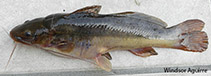
>
Siluriformes (Catfishes) >
Heptapteridae (Three-barbeled catfishes)
Etymology: Rhamdia: Brazilian vernacular name, Nhamdia/Jamdia (Ref. 45335).
Eponymy: Abbé Florentin-Louis de Quélen de la Villeglée (d: 1762) was the chaplain on board the ‘Uranie’ circumnavigation expedition (1817–1820) commanded by Freycinet (q. [...] (Ref. 128868), visit book page.
More on authors: Quoy & Gaimard.
Taxonomic Remarks
Junior synonym Rhamdia wagneri (Günther, 1868) is considered as a synonym of Rhamdia guatemalensis (Günther, 1864) in Ref. 108688:575; 108948.
Περιβάλλον: περιβάλλον / κλιματική ζώνη / εύρος βάθους / εύρος διανομής
Οικολογία
; Γλυκού νερού βενθοπελαγικό; pH range: ? - 7.0; εύρος βάθους 0 - 3 m (Ref. 35381). Tropical; 22°C - 28°C (Ref. 2060)
Central and South America: Mexico to central Argentina.
Μέγεθος / Βάρος / Ηλικία
Γεννητική Ωρίμανση: Lm ? range ? - ? cm
Max length : 61.0 cm TL αρσενικό/απροσδιόριστο; (Ref. 40637); μεγ. δημοσιευμένο βάρος: 4.0 kg (Ref. 40637)
Σύντομη περιγραφή
Κλείδες προσδιορισμού | Μορφολογία | Μορφομετρία
Occurs in littoral creeks, over sandy bottoms covered with dead leaves (Ref. 27188). Inhabits also lakes and rivers, but seems to prefer rivers with a very slight current (Ref. 6868). Prefers a muddy bottom covered with leaves and decaying wood, the latter providing for hiding places during the day (Ref. 35381). Feeds on fish and insects (Ref. 27188), benthic zooplankton and crustaceans (Ref. 35381). Omnivorous (Ref. 79585). Mainly nocturnal (Ref. 11225). Possesses poisonous spiny rays. Its sex ratio is 2:1 in favor of females. The male's reproductive apparatus includes multi-lobed testicles and accessory organs for secretion and storage. Fertilization is external. Non-sticking demersal eggs (1.1 to 2.8 mm diameter) are laid down, hatching after about 48 hours at 22°C. Ten days later, the larvae weigh approximately 100 mg but growth is slow (0.5 to 1.15 g per day).
Κύκλος ζωής και συμπεριφορά ζευγαρώματος
Γεννητική Ωρίμανση | Αναπαραγωγή | Γεννοβολία | Αβγά | Γονιμότητα | Προνύμφες
Hernández, C.L., A. Ortega-Lara, G.C. Sánchez-Garcés, M.H. Alford, 2015. Genetic and morphometric evidence for the recognition of several recently synonymized species of Trans-Andean Rhamdia (Pisces: Siluriformes: Heptapteridae). Copeia 103(3):563-579. (Ref. 108688)
Κατάσταση Κόκκινου Καταλόγου IUCN (Ref. 130435: Version 2025-2 (Global))
Απειλή για τον άνθρωπο
Harmless
Ανθρώπινες χρήσεις
αλιεία: περιορισμένης εμπορικότητας; Υδατοκαλλιέργειες: Εμπορικό(ά)
Εργαλεία
Ειδικές εκθέσεις
Λήψη XML
Διαδικτυακές πηγές
Εκτιμήσεις βάσει μοντέλων
Δείκτης φυλογενετικής ποικιλότητας (Αναφ.
82804): PD
50 = 0.5000 [Uniqueness, from 0.5 = low to 2.0 = high].
Bayesian length-weight: a=0.00912 (0.00783 - 0.01062), b=3.02 (2.98 - 3.06), in cm total length, based on LWR estimates for this species (Ref.
93245).
Τροφικό Επίπεδο (Αναφ.
69278): 3.9 ±0.3 se; based on diet studies.
Ελαστικότητα (Αναφ.
120179): Υψηλό, ελάχιστος χρόνος για διπλασιασμό πληθυσμού < 15 μήνες (Fec=41,334).
Ευπάθεια στην αλιεία (Ref.
59153): Moderate vulnerability (44 of 100).
🛈
Θρεπτικά συστατικά (Ref.
124155): Calcium = 91.5 [50.5, 198.1] mg/100g; Iron = 1.02 [0.58, 1.80] mg/100g; Protein = 16.5 [15.4, 17.6] %; Omega3 = 0.239 [0.098, 0.592] g/100g; Selenium = 51.7 [20.4, 122.1] μg/100g; VitaminA = 55.8 [19.4, 147.0] μg/100g; Zinc = 1.55 [1.06, 2.24] mg/100g (wet weight);