>
Lophiiformes (Anglerfishes) >
Oneirodidae (Dreamers)
Etymology: Bertella: After Erik Bertelsen (1912-1993) who served as curator of the 'Dana' collections at Danmarks Fiskeri-og Havundersøgelser, Charlottenlund, Denmark. (Ref.86949).
Eponymy: Dr Erik ‘Bertel’ Bertelsen (1912–1993) was a celebrated Danish fisheries biologist and ichthyologist at the Zoological Museum of the University of Copenhagen. [...] (Ref. 128868), visit book page.
Ambiente: milieu / zona climatica / distribuzione batimetrica / gamma di distribuzione
Ecologia
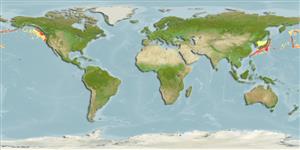
marino batidemersale; distribuzione batimetrica 805 - 3475 m (Ref. 58018). Temperate; 55°N - 14°N (Ref. 123295)
Pacific Ocean.
Dimensione / Peso / Età
Maturità: Lm ? range ? - ? cm
Max length : 10.2 cm SL maschio/sesso non determinato; (Ref. ); 8.4 cm SL (female); common length :559 cm TL (female)
Breve descrizione
Chiavi di identificazione | Morfologia | Morfometria
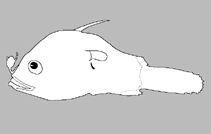
Raggi dorsali molli (totale) : 5 - 6; Raggi anali molli: 4 - 5. Metamorphosed females distinguished by the following characteristics: hyomandibular bone with single head; wide ethmoid cartilage and vomer, wider than distance between anterolateral tips of lateral ethmoids and frontals; presence of vomerine teeth in juvenile, lost with growth in adults; depressed ethmoid region, narrow and oval nasal foramina; frontals long and anterior in position, overhanging and extending past the anterior limits of the ethmoid cartilage and vomer; nearly linear dorsal margin of frontals; ventromedial extensions of the frontals approach each other on midline, making contact with parasphenoid; frontals separated from prootics; presence of pterosphenoid anterior end of illicial trough is wider and shallower than posterior end; well developed sphenotic spines; well developed symphysial spine on lower jaw; well developed quadrate spine; deeply notched posterior margin of opercle; long and narrow subopercle, dorsal end slender and tapering to a point, oval ventral end; absence of first pharyngobranchial; reduced and toothless second pharyngobranchial; second hypobranchial absent; caudal fin rays without internal pigmentation; illicium longer than length of esca bulb; pterygoiphore of illicium cylindrical throughout its length, emerging on snout from between frontal bones, anterior end slightly exposed, posterior end concealed beneath skin; well developed first ray of dorsal fin; dorsal fin rays 5-6; anal fin rays 4-5; short and broad pectoral fin lobe, shorter than longest rays of pectoral fin; pectoral fin rays 18-22; coracoid lacking posteroventral process; simple pelvic bones, with or without distal expansion; skin smooth and naked, without dermal spinules; darkly pigmented skin of caudal peduncle extends well past base of caudal fin (Ref. 86949).
Also caught with plankton nets.
Ciclo vitale e comportamento di accoppiamento
Maturità | Riproduzione | Deposizione | Uova | Fecondità | Larve
Masuda, H., K. Amaoka, C. Araga, T. Uyeno and T. Yoshino, 1984. The fishes of the Japanese Archipelago. Vol. 1. Tokai University Press, Tokyo, Japan. 437 p. (text). (Ref. 559)
Stato della Lista Rossa IUCN (Ref. 130435: Version 2025-2 (Global))
Minaccia per l'uomo
Harmless
Usi umani
Pesca: bycatch
Strumenti
Rapporti speciali
Scarica XML
Fonti Internet
Stime basate su modelli
Temperatura preferita (Fonte Biblio.
123201): 2.1 - 3, mean 2.4 °C (based on 30 cells).
Indice di diversità filogenetica (Fonte Biblio.
82804): PD
50 = 1.0000 [Uniqueness, from 0.5 = low to 2.0 = high].
Bayesian length-weight: a=0.01995 (0.00906 - 0.04395), b=3.01 (2.83 - 3.19), in cm total length, based on all LWR estimates for this body shape (Ref.
93245).
Livello trofico (Fonte Biblio.
69278): 3.9 ±0.6 se; based on size and trophs of closest relatives
Resilienza (Fonte Biblio.
120179): Alto, tempo minimo di raddoppiamento della popolazione meno di 15 mesi (Preliminary K or Fecundity.).
Vulnerabilità della pesca (Ref.
59153): Low vulnerability (10 of 100).
🛈