>
Lophiiformes (Anglerfishes) >
Oneirodidae (Dreamers)
Etymology: Oneirodes: Greek, 'oneiros' = a dream or dreamlike or out of a dream (suggesting this fish is so strange and marvelous that can exist only in dreams) (Ref. 86949).
Environnement : milieu / zone climatique / profondeur / gamme de distribution
Écologie
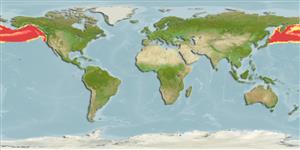
marin bathypélagique; profondeur 200 - 2000 m (Ref. 50550), usually 600 - 850 m (Ref. 86949). Deep-water; 66°N - 30°N, 142°E - 117°W
North Pacific: Okhotsk and Bering seas and off British Columbia, Canada (Ref. 11980).
Taille / Poids / Âge
Maturité: Lm ? range ? - ? cm
Max length : 23.0 cm TL mâle / non sexé; (Ref. 56582); common length : 14.8 cm TL mâle / non sexé; (Ref. 56582); poids max. publié: 450.00 g (Ref. 56582)
Description synthétique
Clés d'identification | Morphologie | Morphométrie
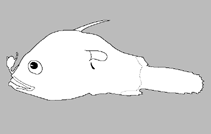
Épines dorsales (Total) : 0; Rayons mous dorsaux (Total) : 6 - 7; Épines anales: 0; Rayons mous anaux: 4; Vertèbres: 19. Escal bulb bearing an anterior appendage with numerous long filaments at its distal end, a pair of medial appendages with highly branched filaments, a short round papilla and posterior appendages with 2 short filaments (Ref. 559).
Characterized by having similar characteristics like that of O.eschrichtii and O.anisacanthus; posterior margin of the upper part of subopercle is indented to deeply notched; length of ventral fork of opercle 28.6-35% SL; ratio of lengths of dorsal and ventral forks of opercle 0.55-0.60; absence of epibranchial teeth; presence of teeth on pharyngobranchial II; upper jaw teeth 23-39; lower jaw teeth 24-40; teeth on vomer 4-8; dorsal fin rays 6-7; anal fin rays 4; pectoral fin rays 15-18; head length 37.6-49.1% SL; head depth 39.1-50.8% SL; length of premaxilla 29.1-38.6% SL; lower jaw length 44.1-56.1% SL; illicial length 23.1-38.6% SL (Ref. 86949).
Body shape (shape guide): short and / or deep.
Cycle de vie et comportement reproducteur
Maturité | Reproduction | Frai | Œufs | Fécondité | Larves
Masuda, H., K. Amaoka, C. Araga, T. Uyeno and T. Yoshino, 1984. The fishes of the Japanese Archipelago. Vol. 1. Tokai University Press, Tokyo, Japan. 437 p. (text). (Ref. 559)
Statut dans la liste rouge de l'IUCN (Ref. 130435: Version 2025-2 (Global))
Menace pour l'homme
Harmless
Utilisations par l'homme
Outils
Articles particuliers
Télécharger en XML
Sources Internet
Estimations basées sur des modèles
Température préférée (Réf.
123201): 1.6 - 3.7, mean 2.3 °C (based on 51 cells).
Indice de diversité phylogénétique (Réf.
82804): PD
50 = 0.5000 [Uniqueness, from 0.5 = low to 2.0 = high].
Bayesian length-weight: a=0.01995 (0.00906 - 0.04395), b=3.01 (2.83 - 3.19), in cm total length, based on all LWR estimates for this body shape (Ref.
93245).
Niveau trophique (Réf.
69278): 4.5 ±0.80 se; based on food items.
Résilience (Réf.
120179): Milieu, temps minimum de doublement de population : 1,4 à 4,4 années (Preliminary K or Fecundity.).
Vulnérabilité de la pêche (Ref.
59153): Low vulnerability (13 of 100).
🛈