>
Lophiiformes (Anglerfishes) >
Caulophrynidae (Fanfins)
Etymology: Caulophryne: Greek, 'kaulos' or 'caulis' = stem + Greek, 'phryne' = toad (according to Goode and Bean (1896): "a 'phryne'-like fish with the cephalic tentacle supported on a stemlike base") ( Ref. 86949); jordani: jordani named for David Starr Jordan, possibly America's ichthyologist (Ref. 4525).
Eponymy: Dr David Starr Jordan (1851–1931) was a leading American ichthyologist, physician, educator, peace activist and believer in eugenics; moreover, he was founding President of Stanford University. [...] (Ref. 128868), visit book page.
More on authors: Goode & Bean.
Milieu: milieu / Klimaatzone / Diepte / verspreidingsgebied
Ecologie
marien bathypelagisch; diepte 100 - 1510 m (Ref. 5951). Deep-water
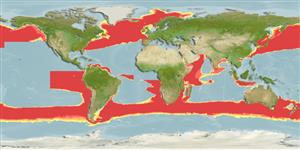
Circumglobal.
Grootte / Gewicht / Leeftijd
Maturiteit: Lm ? range ? - ? cm
Max length : 11.0 cm TL mannelijk / geslacht onbekend; (Ref. 7300); 20.0 cm TL (female)
Korte beschrijving
Determinatiesleutels | Morfologie | Morfometrie
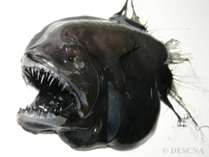
Dorsale stekels (totaal) : 0; Dorsale zachte stralen (totaal) : 16; Anale stekels: 0; Anale zachte stralen: 17. Illicium pigmented except near esca, with 5-14 elongate translucent filaments along entire length, al but distal-most arising from posterior margin (Ref. 13608); length of illicium 16.8-36.8%SL; stem of illicium pigmented except near esca; esca with an elongate filamentous anterolateral appendage; 2 distal appendages, each bearing numerous filaments, anterior most short and stout, opaque along posterior margin, posterior most considerably more slender; posterolateral appendage bearing numerous short filaments and with palmate opaque distal tip; dorsal fin rays 16-19; anal fin rays 14-18; pectoral fin rays 16-19; upper jaw teeth 17-39; lower jaw teeth 12-26; teeth on vomer 2-5 (Ref. 86949).
Body shape (shape guide): short and / or deep.
Bathy- and mesopelagic (Ref. 75154). Males parasitic on the females (Ref. 559).
Levenscyclus en paargedrag
Maturiteit | Voortplanting | Paaien | Eieren | Fecunditeit | Larven
Paxton, J.R., D.F. Hoese, G.R. Allen and J.E. Hanley, 1989. Pisces. Petromyzontidae to Carangidae. Zoological Catalogue of Australia, Vol. 7. Australian Government Publishing Service, Canberra, 665 p. (Ref. 7300)
Status op de Rode Lijst van het IUCN (Ref. 130435: Version 2025-2 (Global))
Gevaar voor de mens
Harmless
Gebruik door de mens
Visserij: bycatch
Tools
Speciale rapporten
Download XML
Internetbronnen
Schattingen op basis van modellen
Gewenste temperatuur (Ref.
123201): 1.1 - 13.7, mean 7.1 °C (based on 1411 cells).
Fylogenetische diversiteitsindex (Ref.
82804): PD
50 = 0.5938 [Uniqueness, from 0.5 = low to 2.0 = high].
Bayesian length-weight: a=0.01995 (0.00906 - 0.04395), b=3.01 (2.83 - 3.19), in cm total length, based on all LWR estimates for this body shape (Ref.
93245).
Trofisch niveau (Ref.
69278): 3.9 ±0.5 se; based on size and trophs of closest relatives
Kwetsbaarheid van de visserij (Ref.
59153): Low vulnerability (10 of 100).
🛈