>
Syngnathiformes (Pipefishes and seahorses) >
Syngnathidae (Pipefishes and seahorses) > Nerophinae
Etymology: Doryrhamphus: Greek, dory = lance + Greek, rhamphos = bill, beak (Ref. 45335).
Περιβάλλον: περιβάλλον / κλιματική ζώνη / εύρος βάθους / εύρος διανομής
Οικολογία
Θαλασσινό(ά) Υφαλόφιλο(α); μη μεταναστευτικό(ά) (Ref. 52884); εύρος βάθους 1 - 30 m (Ref. 90102). Temperate
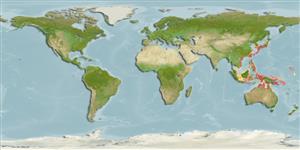
Western Pacific: Japan to Indonesia. Also from Korea Rep.
Μέγεθος / Βάρος / Ηλικία
Γεννητική Ωρίμανση: Lm ? range ? - ? cm
Max length : 8.5 cm TL αρσενικό/απροσδιόριστο; (Ref. 559)
Σύντομη περιγραφή
Κλείδες προσδιορισμού | Μορφολογία | Μορφομετρία
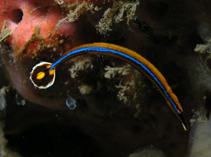
Μαλακές ραχιαίες ακτίνες (συνολικά) : 21 - 23; Μαλακές εδρικές ακτίνες: 4. Body orange yellow when fresh. Trunk rings 20, tail rings 15. Lateral trunk ridge continuous with inferior tail ridge; superior trunk and tail ridges extending forward over 4 trunk rings. Three serrated ridges dorsally on snout, the median ridge heavily serrated. Body ridges illustrating single spine except anterior six of superior trunk ridge and 3 lateral trunk ridge which has double spines. No ventrolateral projection on the snout.
Body shape (shape guide): eel-like; Cross section: compressed.
Inhabits small caves in sublittoral rocky reefs. Reported from tide pools to depths of at least 25 m offshore, but mostly seen in shallow depths (Ref. 48635). An active cleaner that shares crevices with shrimps, large mud crabs and sometimes moray eels (Ref. 48635). Solitary or in pairs near sponges and Diadema sea urchins (Ref 90102). Ovoviviparous (Ref. 205). The male carries the eggs in a brood pouch which is found under the tail (Ref. 205). Spawns from the end of May to September. Monogamous and always in home-ranging pairs, that is they do not defend an exclusive territory (Ref. 52884).
Κύκλος ζωής και συμπεριφορά ζευγαρώματος
Γεννητική Ωρίμανση | Αναπαραγωγή | Γεννοβολία | Αβγά | Γονιμότητα | Προνύμφες
Monogamous mating is observed as both obligate and genetic (Ref. 52884). Male carries the eggs in a brood pouch (Ref. 205).
Masuda, H., K. Amaoka, C. Araga, T. Uyeno and T. Yoshino, 1984. The fishes of the Japanese Archipelago. Vol. 1. Tokai University Press, Tokyo, Japan. 437 p. (text). (Ref. 559)
Κατάσταση Κόκκινου Καταλόγου IUCN (Ref. 130435: Version 2025-2 (Global))
Απειλή για τον άνθρωπο
Harmless
Ανθρώπινες χρήσεις
Εργαλεία
Ειδικές εκθέσεις
Λήψη XML
Διαδικτυακές πηγές
Εκτιμήσεις βάσει μοντέλων
Προτιμώμενη θερμοκρασία (Αναφ.
123201): 20.7 - 29.3, mean 28.6 °C (based on 1159 cells).
Δείκτης φυλογενετικής ποικιλότητας (Αναφ.
82804): PD
50 = 0.5010 [Uniqueness, from 0.5 = low to 2.0 = high].
Bayesian length-weight: a=0.00098 (0.00038 - 0.00252), b=3.05 (2.83 - 3.27), in cm total length, based on LWR estimates for this (Sub)family-body shape (Ref.
93245).
Τροφικό Επίπεδο (Αναφ.
69278): 3.7 ±0.50 se; based on food items.
Ελαστικότητα (Αναφ.
120179): Υψηλό, ελάχιστος χρόνος για διπλασιασμό πληθυσμού < 15 μήνες (Preliminary K or Fecundity.).
Ευπάθεια στην αλιεία (Ref.
59153): Low vulnerability (10 of 100).
🛈