>
Cichliformes (Cichlids, convict blennies) >
Cichlidae (Cichlids) > Pseudocrenilabrinae
Etymology: Rhamphochromis: Greek, rhamphos = bill, peak + Greek, chromis = a fish, perhaps a perch (Ref. 45335).
More on author: Boulenger.
Taxonomic Remarks
Quote Turner et al. (Ref. 55949): "We consider that both R. leptosoma and R. melanotus are probably junior synonyms of R. esox. If this is accepted, R. esox can be considered the most distinctive and readily identified species of the genus."
Environnement : milieu / zone climatique / profondeur / gamme de distribution
Écologie
; eau douce démersal; pH range: 7.4 - 8.5; dH range: 5 - 30; profondeur 2 - 65 m (Ref. 55949). Tropical; 23°C - 27°C (Ref. 13614); 9°S - 15°S
Africa: Endemic to Lake Malawi.
Longueur à la première maturité / Taille / Poids / Âge
Maturité: Lm ?, range 19 - ? cm
Max length : 42.0 cm SL mâle / non sexé; (Ref. 55949)
Description synthétique
Clés d'identification | Morphologie | Morphométrie
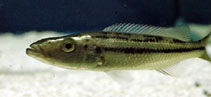
Diagnosis: elongated and very streamlined shape; body in cross-section more rounded than congenerics; frequently exhibits a horizontal stripe (Ref. 55949).
Body shape (shape guide): elongated.
Inhabits the open water (Ref. 5595). Widely distributed in shelf and rocky reef zones, usually where the bottom is fairly shallow; rarely found offshore; small juveniles widely distributed in the littoral zone in swampy, sandy and rocky habitats; adults regularly encountered near sandy beaches in the shallows (Ref. 55949). Feeds on fish species like the small Utaka and the lake sardine Usipa (Engraulicypris sardella) (Ref. 5595).
Cycle de vie et comportement reproducteur
Maturité | Reproduction | Frai | Œufs | Fécondité | Larves
Maréchal, C., 1991. Rhamphochromis. p. 422-424. In J. Daget, J.-P. Gosse, G.G. Teugels and D.F.E. Thys van den Audenaerde (eds.) Check-list of the freshwater fishes of Africa (CLOFFA). ISNB, Brussels; MRAC, Tervuren; and ORSTOM, Paris. Vol. 4. (Ref. 5689)
Statut dans la liste rouge de l'IUCN (Ref. 130435: Version 2025-2 (Global))
Menace pour l'homme
Harmless
Utilisations par l'homme
Pêcheries: commercial; Aquarium: Commercial
Outils
Articles particuliers
Télécharger en XML
Sources Internet
Estimations basées sur des modèles
Indice de diversité phylogénétique (Réf.
82804): PD
50 = 0.5156 [Uniqueness, from 0.5 = low to 2.0 = high].
Bayesian length-weight: a=0.00389 (0.00180 - 0.00842), b=3.12 (2.94 - 3.30), in cm total length, based on all LWR estimates for this body shape (Ref.
93245).
Niveau trophique (Réf.
69278): 4.2 ±0.73 se; based on food items.
Résilience (Réf.
120179): Milieu, temps minimum de doublement de population : 1,4 à 4,4 années (Preliminary K or Fecundity.).
Vulnérabilité de la pêche (Ref.
59153): Moderate vulnerability (41 of 100).
🛈