Umwelt: Milieu / Klimazone / Tiefenbereich / Verbreitungsgebiet
Ökologie
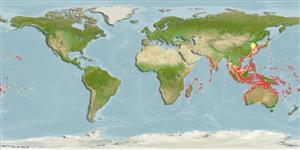
seewasser; brackwasser riff-verbunden; tiefenbereich 1 - 75 m (Ref. 9710). Tropical; 43°N - 32°S, 31°E - 168°W
Indo-Pacific: East Africa eastward through northern Australia extending to Samoa; north to southern Japan.
Größe / Gewicht / Alter
Geschlechtsreife: Lm ? range ? - ? cm
Max length : 50.0 cm TL Männchen/unbestimmt; (Ref. 2334)
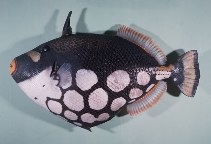
Rückenflossenstacheln (insgesamt) : 3; Rückenflossenweichstrahlen (insgesamt) : 25 - 27; Afterflossenstacheln: 0; Afterflossenweichstrahlen: 21 - 27; Wirbelzahl: 18. Unique color pattern of large white spots on belly, black spots on yellow background on the back, yellow snout. A white or yellowish band across snout in front of eye. Lips and the area around mouth orange-yellow. A broad vertical white, slightly yellowish band on caudal fin. Scales enlarged above pectoral-fin base and just behind gill opening to form a flexible tympanum. Rows of small anteriorly projecting spines on caudal peduncle. A prominent groove extending anteriorly from front of eye for a distance of about 1 eye diameter. Mouth terminal. Caudal peduncle compressed (Ref 9770). 39-50 rows of plate-like scales.
Body shape (shape guide): short and / or deep; Cross section: oval.
Lives in clear coastal to outer reef habitats (Ref. 48637). Occurs in clear seaward reefs adjacent to steep drop-offs. A solitary species (Ref. 9710). Uncommon to rare throughout most of its range (Ref. 9770). Adults usually seen along deep drop-offs, swimming about openly and may retreat to caves when approached. Juveniles secretive in small caves with rich invertebrate growth (Ref. 48637). Diet consists of sea urchins, crabs and other crustaceans, mollusks, and tunicates (Ref. 9770). Marketed fresh (Ref. 9770). Among the most highly prized aquarium fishes (Ref. 1602).
Lebenszyklus und Paarungsverhalten
Geschlechtsreife | Fortpflanzung | Ablaichen | Eier | Fruchtbarkeit | Larven
Distinct pairing (Ref. 205). Spawning occurs in patches of mixed coral rubble and sand on clear seaward reefs (Ref. 37816).
Matsuura, K., 2001. Balistidae. Triggerfishes. p. 3911-3928. In K.E. Carpenter and V. Niem (eds.) FAO species identification guide for fishery purposes. The living marine resources of the Western Central Pacific. Vol. 6. Bony fishes part 4 (Labridae to Latimeriidae), estuarine crocodiles. FAO, Rome. (Ref. 9770)
IUCN Rote Liste Status (Ref. 130435: Version 2025-2 (Global))
Bedrohung für Menschen
Reports of ciguatera poisoning (Ref. 4690)
Nutzung durch Menschen
Fischereien: weniger kommerziell; Aquarium: Kommerziell
Tools
Zusatzinformationen
Download XML
Internet Quellen
Schätzungen auf der Grundlage von Modellen
Bevorzugte Temperatur (Ref.
123201): 23.3 - 28.8, mean 27.3 °C (based on 552 cells).
Phylogenetischer Diversitätsindex (Ref.
82804): PD
50 = 0.7500 [Uniqueness, from 0.5 = low to 2.0 = high].
Bayesian length-weight: a=0.02754 (0.01326 - 0.05722), b=2.91 (2.74 - 3.08), in cm total length, based on LWR estimates for this (Sub)family-body shape (Ref.
93245).
Trophische Ebene (Ref.
69278): 3.3 ±0.39 se; based on food items.
Widerstandsfähigkeit (Ref.
120179): mittel, Verdopplung der Population dauert 1,4 - 4,4 Jahre. (Preliminary K or Fecundity.).
Anfälligkeit der Fischerei (Ref.
59153): Moderate vulnerability (40 of 100).
🛈
Nährstoffe (Ref.
124155): Calcium = 31 [13, 79] mg/100g; Iron = 0.523 [0.278, 1.149] mg/100g; Protein = 18.6 [16.5, 20.8] %; Omega3 = 0.12 [0.06, 0.23] g/100g; Selenium = 38.9 [19.2, 82.4] μg/100g; VitaminA = 43 [12, 164] μg/100g; Zinc = 1.12 [0.75, 1.68] mg/100g (wet weight);