>
Callionymiformes (Dragonets) >
Callionymidae (Dragonets)
Etymology: Callionymus: Greek, kallion, comparative of kallos = beautiful + Greek, onyma = name; with a better name.
More on author: Linnaeus.
Окружающая среда: среда / климатическая зона / пределы глубины / диапазон распространения
экология
морской демерсальный; пределы глубины 1 - 440 m (Ref. 5968), usually 5 - 30 m (Ref. 27115). Temperate; 16°C - 20°C (Ref. 27115); 66°N - 16°N, 42°W - 42°E
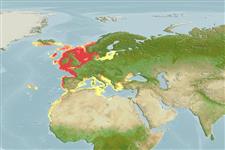
Eastern Atlantic: southern Iceland and Norway south to Mauritania, including the northern Mediterranean, Gibraltar, and Algeria, western Black Sea, Aegean and Adriatic Sea, Azores and the Canary Islands.
Длина при первой зрелости / Размер / Вес / Возраст
половая зрелость: Lm 17.4 range ? - ? cm
Max length : 30.5 cm TL самец/пол неопределен; (Ref. 59122); 25.0 cm TL (female); common length : 15.0 cm TL самец/пол неопределен; (Ref. 3397); наибольший возраст (опубликованны данные): 7 годы (Ref. 72462)
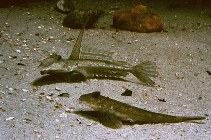
колючие лучи спинного плавника (общее число) : 4; членистые (мягкие) лучи спинного плавника (общее число) : 8 - 10; членистые (мягкие) лучи анального плавника: 9. Gill opening dorsal. Usually antrorse (forward-pointing) tip at base of preopercular spine. Rays of second dorsal unbranched except for the last, which is divided at base (Ref. 232). Snout length 2-3 times the diameter of the eye (Ref. 35388).
Body shape (shape guide): elongated.
Occurs on sand and muddy bottoms from sublittoral to 200 m (Ref. 6444) and to 400 m or more (Ref. 9900). Feeds on small invertebrates, mainly worms and crustaceans. Territorial, males aggressive with each other. Complex courtship behavior consists of 4 phases: courtship, pairing, ascending, releasing eggs and milt. Pelagic eggs and larvae (Ref. 5968). Minimum depth reported from Ref. 27115. Neither opercular spine gland nor anterolateral glandular groove with venom gland is present (Ref. 57406).
Complex courtship behavior with 4 phases: courtship, pairing, ascending, releasing eggs and milt (Ref. 5968).
Davis, W.P and R. Fricke, 1990. Callionymidae. p. 921-924. In J.C. Quero, J.C. Hureau, C. Karrer, A. Post and L. Saldanha (eds.) Check-list of the fishes of the eastern tropical Atlantic (CLOFETA). JNICT, Lisbon, SEI, Paris; and UNESCO, Paris. Vol. 2. (Ref. 6941)
Статус Красного Списка МСОП (Ref. 130435: Version 2025-2 (Global))
Использование человеком
рыболовство: не имеет хозяйственного значения; аквариум: общественные аквариумы
дополнительная информация
инструменты
Специальные отчеты
Скачать в формате XML
ресурсы в Интернет
Оценки, основанные на моделях
Предпочтительная температура (ссылка
123201): 11.7 - 19.5, mean 13.3 °C (based on 92 cells).
Индекс филогенетического разнообразия (ссылка
82804): PD
50 = 0.5000 [Uniqueness, from 0.5 = low to 2.0 = high].
Bayesian length-weight: a=0.01072 (0.00893 - 0.01286), b=2.78 (2.73 - 2.83), in cm total length, based on LWR estimates for this species (Ref.
93245).
Трофический уровень (ссылка
69278): 3.4 ±0.5 se; based on diet studies.
Generation time: 2.6 ( na - na) years. Estimated as median ln(3)/K based on 2
growth studies.
устойчивость к внешним воздействиям (ссылка
120179): средний (среднего размера), минимальное время удвоения популяции 1.4-4.4 года (K=0.43-0.47; tmax=6).
Уязвимость рыбной ловли (Ref.
59153): Low to moderate vulnerability (29 of 100).
🛈
Питательные вещества (Ref.
124155): Calcium = 54.2 [31.1, 99.0] mg/100g; Iron = 0.386 [0.218, 0.684] mg/100g; Protein = 17.9 [17.0, 18.8] %; Omega3 = 0.478 [0.259, 0.840] g/100g; Selenium = 18.5 [9.3, 38.6] μg/100g; VitaminA = 13.4 [3.7, 47.5] μg/100g; Zinc = 0.617 [0.442, 0.885] mg/100g (wet weight);